Email Verification Tools Compared: ZeroBounce vs LeadMagic vs BounceBan vs Reoon (2026)
September 6, 2025 · 5 min read · by Ahmet Faruk Yilmaz, Founder of Asphia
TL;DR
LeadMagic is the best all-rounder for B2B outbound in 2026: it combines email verification with contact enrichment in one API call, making it the most efficient choice. ZeroBounce wins on raw volume and deliverability data depth. BounceBan handles catch-all domains better than most. Reoon is solid but only worth it if you already have access.
If you are running B2B cold email at any real volume, the email verifier you choose directly affects your deliverability, your sender reputation, and your cost per booked meeting. Here is a practical comparison of four tools that come up most often in modern outbound stacks: ZeroBounce, LeadMagic, BounceBan, and Reoon.
The short answer: LeadMagic is the most efficient choice for outbound teams that also need enrichment. ZeroBounce is the right pick for pure bulk verification at scale. BounceBan is worth adding specifically for catch-all domains. Reoon is a capable tool, but its value depends heavily on your existing account access.
Why Email Verification Matters More Than Ever
 One API call before the send beats one support ticket after the block.
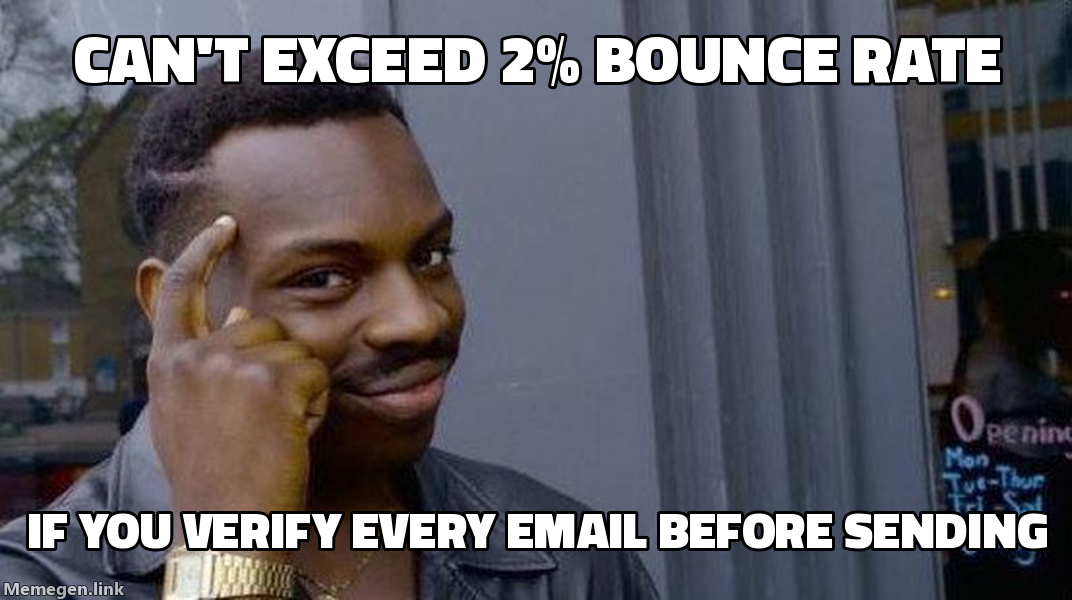
Inbox placement algorithms have tightened. Gmail and Outlook both track engagement signals at the domain level, and a spike in hard bounces can put your entire sending domain in a bad position within days. Most cold email platforms will flag or suspend accounts that exceed roughly two percent hard bounce rates.
Verifying before you send is not optional if you are running any volume. The question is which tool to run, and whether to stack providers for difficult address types.
ZeroBounce: Best for Pure Volume
ZeroBounce is the most established name in the space. It offers a batch file upload endpoint that can process large lists server-side, which is how you get genuinely fast throughput on tens of thousands of addresses. The API is well-documented and returns detailed status fields including abuse status, spam trap flags, and domain-level scoring alongside the core valid/invalid/catch-all result.
For teams running large list builds from Apollo or similar tools before importing into their sending platform, ZeroBounce handles volume well. Its credits-based pricing scales reasonably if you are verifying consistently rather than in occasional large spikes.
The limitation is that it only verifies. It does not enrich. If you need contact data alongside verification, you are making two separate calls to two separate services.
ZeroBounce integrates directly with several cold email platforms and CRMs, which reduces friction for teams that want automated list hygiene rather than a manual step in their workflow. See how this fits into a Clay enrichment service workflow for a fuller picture.
LeadMagic: Best for B2B Outbound Efficiency
LeadMagic stands apart because its email validation endpoint also returns enrichment data, including company name, domain, and basic firmographic fields, in the same response. For B2B outbound where you are building prospect lists and verifying them in the same pipeline, this collapses two steps into one.
The API accepts a single email and returns email status (valid, invalid, catch-all, unknown) alongside contact and company context. The credit cost per call is modest, and the dual-purpose nature means you are getting more information per credit than a pure verifier provides.
In high-frequency outbound operations, where you might be verifying leads sourced from LinkedIn or Apollo before they hit your sending campaign, LeadMagic’s combined response reduces the number of API integrations you need to maintain. It works well as the primary gate in an SDR pipeline that runs verification before generation and send.
For teams building done-with-you outbound systems, having a single enrichment-plus-verification endpoint simplifies the architecture considerably.
BounceBan: Best for Catch-All Domains
Catch-all domains accept all inbound email regardless of whether the individual mailbox exists. Standard verifiers return unknown status for these addresses, leaving you to either skip them entirely or accept elevated bounce risk.
BounceBan applies additional probing specifically designed for catch-all domains. It uses SMTP-level checks and behavioral signals to distinguish between addresses on catch-all domains that are likely active versus those that are almost certainly non-functional. This makes it a useful secondary layer rather than a primary verifier for your entire list.
A practical approach: run your primary verifier first, then push only the catch-all results through BounceBan. This keeps your per-lead verification cost reasonable while reducing the uncertainty on the most problematic address type. Catch-all addresses often appear on large enterprise domains, which are frequently high-value targets in B2B outbound, so resolving them correctly is worth the extra step.
Reoon: Capable but Access-Dependent
Reoon is a technically capable verifier with solid accuracy on standard business addresses. It supports both single-address and bulk verification, and its API is straightforward to integrate. However, whether it belongs in your stack depends on your existing account access and pricing arrangement.
If you have an account already, Reoon performs well as a primary or secondary verifier. If you are evaluating new tools from scratch, the others on this list offer more differentiated value for the typical B2B outbound use case.
How to Choose
Start with your use case. If you need enrichment alongside verification and are running a B2B outbound operation, LeadMagic is the most efficient single tool. If you are processing very large lists and want deep deliverability scoring, ZeroBounce has the infrastructure for it. Add BounceBan as a secondary layer specifically for catch-all domains when your target companies tend to use them.
For GDPR-compliant cold email outreach, pair whichever verifier you choose with a proper data processing workflow. Verification protects deliverability, but compliance requires the right lawful basis, clear opt-outs, and thoughtful targeting from the start.
At Asphia, verification sits inside the outbound pipeline as an automated gate before any email is generated or sent. Every lead passes through verification before copy is written and before a human approves the send. That sequence keeps bounce rates low without adding manual work to the review step. If you want to see how that fits together end to end, the managed outbound service page walks through the full system.
Get the signal tier list in your inbox.
We rank signals from S to D to decide who gets a cold email and who does not. You get the list once. No follow-up emails.
Request received. The list lands in your inbox within 24 hours.
One more step: send the prepared request to [email protected]
FAQ
What is the most accurate email verification tool in 2026?
Accuracy varies by provider and list type. ZeroBounce and LeadMagic both perform well on standard business emails. For catch-all domains, BounceBan applies additional checks that reduce false positives. No tool is 100% accurate on catch-all addresses, which is why running two providers on uncertain results is worth the extra cost.
Can I use email verification tools for GDPR-compliant outreach?
Verification tools themselves do not make your outreach GDPR-compliant. They reduce bounce rates and protect sender reputation. Compliance comes from your lawful basis for processing, your opt-out handling, and your targeting approach. Pair verification with a GDPR-aware outbound strategy to stay on the right side of regulations.
What is a catch-all email domain and how should I handle it?
A catch-all domain accepts all incoming emails regardless of whether the mailbox exists, so standard verification returns unknown status. BounceBan specializes in validating catch-all addresses using SMTP-level probing and behavioral signals. For these domains, accept slightly higher bounce risk or use a secondary verification layer before sending.
How does email verification affect cold email deliverability?
Sending to invalid addresses spikes your hard-bounce rate. Most major ESPs and cold email platforms throttle or suspend accounts that exceed roughly 2 percent hard bounces. Verifying your list before sending keeps bounce rates low, which protects your sending domains and keeps you in the inbox rather than spam folders.
Is ZeroBounce better than LeadMagic for B2B outbound?
For pure bulk list verification, ZeroBounce has more credits-based pricing tiers and deep deliverability scoring. For B2B outbound where you also need contact enrichment alongside verification, LeadMagic wins because a single API call returns email status plus company data. Choose based on whether you want verification alone or verification plus enrichment.
Should I use one email verifier or stack multiple providers?
For high-volume campaigns or expensive lists, stacking two providers on uncertain or catch-all results is worth the cost. Run your primary verifier first, then push only unknowns and catch-alls through a secondary provider. This waterfall approach catches errors that any single provider misses and reduces wasted sends without doubling your total verification spend.

Ahmet Faruk Yilmaz
Founder of Asphia. He builds and runs signal-based B2B outbound engines for lean teams, and has booked meetings with teams at companies across five markets. Writes about cold email, Clay, deliverability, and GTM engineering.
Want this run for you?
Get a free GTM analysis. We show you the exact engine we would build.
Get your free GTM analysis →