New Domain Email Warmup Checklist: Deliverability Steps Before Day One
June 14, 2026 · 5 min read · by Ahmet Faruk Yilmaz, Founder of Asphia
TL;DR
Before sending a single cold email on a new domain, set up SPF, DKIM, and DMARC, run a 3 to 4 week warmup sequence starting under 20 emails per day, and verify your inbox placement with a seed test. Skipping any step risks permanent blacklisting.
Warming up a new domain is not optional. Spam filters evaluate domain age, sending history, bounce rates, and authentication records before deciding where your email lands. Get the checklist right and your first campaign starts with a clean slate. Get it wrong and you may be blacklisted before a single prospect reads your message.
Step 1: DNS Authentication Records (Non-Negotiable Before Anything Else)
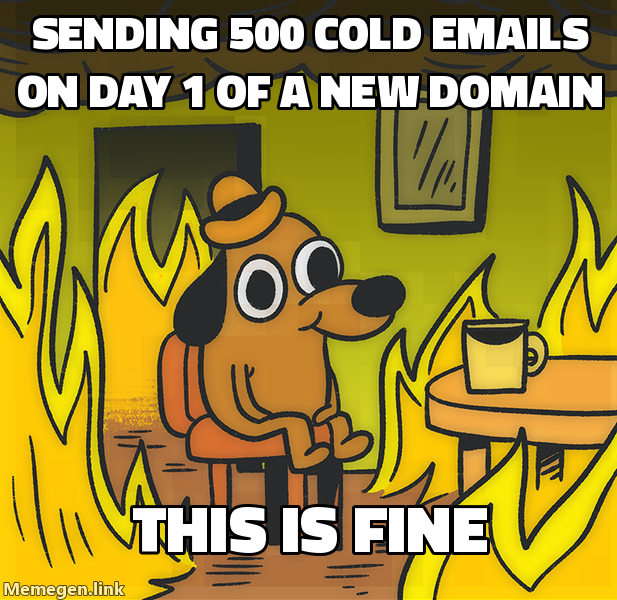 No warmup, no SPF, no DKIM. What could go wrong.
Set these three records in your domain registrar before you send one email:
SPF. A TXT record that lists the mail servers authorized to send on your domain’s behalf. Example: v=spf1 include:_spf.google.com ~all. Use ~all (softfail) rather than -all (hardfail) during warmup to avoid bouncing legitimate test emails.
DKIM. A public/private key pair. Your sending platform generates the private key and signs outgoing messages. You publish the public key as a TXT record. Google Workspace, Microsoft 365, and most cold email platforms generate DKIM keys inside their settings panels.
DMARC. A policy record that tells receiving servers what to do when SPF or DKIM fails. Start with p=none (monitor only) so you receive reports without rejecting anything. After 2 to 3 weeks of clean data, move to p=quarantine.
Verify all three propagated correctly using MXToolbox or a similar checker before moving to step two.
Step 2: Infrastructure Choices That Protect You Long-Term
A few decisions made at setup time save significant pain later:
Use a redirect domain, not your main company domain. Register something like reply-asphia.com that forwards to asphia.com. If that sending domain ends up on a blacklist, your transactional email and website reputation stay untouched.
Pick a business email provider (Google Workspace or Microsoft 365), not a shared host or cheap SMTP relay. Major providers have better IP reputations and are more likely to be whitelisted by corporate mail servers.
Set a custom tracking domain in your cold email platform so click-tracking links show your domain, not the platform’s shared subdomain. Shared tracking domains are frequently flagged.
For guidance on how done-for-you cold email operations handle domain infrastructure at scale, the setup logic carries over directly to your own stack.
Step 3: The Warmup Sequence (Weeks 1 through 4)
Warmup tools (Mailreach, Warmbox, Instantly Warmup, and others) send automated emails between a network of real inboxes and mark them as not spam. This builds your domain and IP reputation gradually.
A conservative schedule:
| Week | Daily Sends | Notes |
|---|---|---|
| 1 | 10 to 15 | Warmup tool only, zero cold outreach |
| 2 | 20 to 30 | Warmup tool continues, seed test at end of week |
| 3 | 35 to 50 | Can begin cold outreach at very low volume |
| 4 | 50 to 70 | Scale cold sends if seed tests show 85 percent or better inbox |
Keep warmup running at 30 to 40 emails per day even after you start real campaigns. It maintains a baseline of positive engagement signals.
Step 4: Deliverability Checks Before You Go Live
Before sending to real prospects, run these checks:
Seed test. Use GlockApps or Mail-Tester to send to a panel of real inboxes at Gmail, Outlook, and Yahoo. The report shows what percentage lands in inbox versus spam. You want 85 percent or higher before starting outreach.
Spam score check. Mail-Tester scores your email content and headers out of 10. Fix anything below 8. Common culprits: missing unsubscribe links, image-heavy formatting, URL shorteners, and trigger words in subject lines.
Blacklist check. Run your sending domain and IP through MXToolbox Blacklist Check. A fresh domain should be clean. If it appears on any list, contact the list operator to request removal before warmup begins.
Bounce rate baseline. Your list must be verified before the first send. A bounce rate above 3 to 5 percent on a new domain can trigger immediate suppression. Use a verification tool to remove invalid addresses. For context on how AI cold email systems manage verification upstream, the principle is the same: clean list first, send second.
Step 5: Content and Volume Rules for the First Campaign
Even a warmed domain can be flagged by bad sending behavior. A few hard rules for week three and beyond:
Keep initial send volume under 50 emails per day per mailbox. Spread sends across the full business day rather than blasting in one batch. Most sending platforms have throttling settings for this.
Write plain-text-first emails. HTML-heavy templates with multiple images and tracked links look like marketing blasts to filters. Cold outreach performs better as a simple text exchange anyway.
Personalize at the subject line and first line. Identical emails sent at volume are a spam signal. Even light personalization (first name, company, one specific signal) meaningfully reduces complaint rates.
Monitor your sending domain’s Google Postmaster Tools dashboard. It shows domain reputation, spam rate, and authentication pass rate directly from Gmail’s perspective. Set it up on day one.
For teams that want to skip the setup overhead entirely, an outbound engine builder approach handles domain provisioning, warmup sequencing, and monitoring as part of standing up the full system.
The checklist is not complicated, but each step depends on the one before it. DNS authentication before warmup. Warmup before real sends. Deliverability verification before you touch a real prospect list. Following the sequence is what separates campaigns that land in inbox from ones that never get seen.
Get the signal tier list in your inbox.
We rank signals from S to D to decide who gets a cold email and who does not. You get the list once. No follow-up emails.
Request received. The list lands in your inbox within 24 hours.
One more step: send the prepared request to [email protected]
FAQ
How long does it take to warm up a new email domain?
A safe warmup takes 3 to 6 weeks. Start with 10 to 20 emails per day and increase by 25 to 30 percent each week. Rushing the ramp by sending hundreds of emails in the first week will trigger spam filters and can permanently damage domain reputation.
What DNS records do I need before warming up a new domain?
You need three records before sending a single email: SPF (a TXT record authorizing your sending server), DKIM (a cryptographic key your mail client signs outgoing messages with), and DMARC (a policy telling receivers what to do with unauthenticated mail). All three must be verified and propagated first.
Can I use my main company domain for cold email outreach?
No. Use a dedicated sending domain that redirects to your main site. If the sending domain gets blacklisted, your core domain and transactional email stay clean. Most agencies set up two or three sending domains per active campaign.
What is a good open rate to aim for during warmup?
During warmup you want positive engagement: replies, opens, and people moving your emails out of spam. Warmup tool open rates typically run above 40 percent because those are controlled inboxes; that number is not comparable to real campaign open rates. For seed tests, inbox placement above 85 percent is generally considered a safe threshold before scaling volume.
Does domain age matter for deliverability?
Yes. Freshly registered domains have no sending history and are treated with more suspicion by spam filters. Purchasing a domain that is at least 30 to 90 days old before you begin warmup gives you a small but meaningful head start on reputation building.
How many emails per day can I send after a full warmup?
A properly warmed mailbox is commonly cited as sustainable at 40 to 80 cold emails per day. Pushing beyond that tends to increase bounce risk and spam complaints. Running multiple warmed mailboxes across several domains is the correct way to scale volume.

Ahmet Faruk Yilmaz
Founder of Asphia. He builds and runs signal-based B2B outbound engines for lean teams, and has booked meetings with teams at companies across five markets. Writes about cold email, Clay, deliverability, and GTM engineering.
Want this run for you?
Get a free GTM analysis. We show you the exact engine we would build.
Get your free GTM analysis →