The LinkedIn and Email Multichannel Playbook That Books More Meetings
October 27, 2025 · 5 min read · by Ahmet Faruk Yilmaz, Founder of Asphia
TL;DR
Run LinkedIn profile views and connection requests before the first cold email. This warms the prospect so your email lands with context rather than as noise. A coordinated multi-touch sequence across both channels consistently outperforms single-channel outreach in booked meetings.
Running cold email alone or LinkedIn alone is leaving meetings on the table. The fastest path to a booked call is to use both channels together in a deliberate sequence so each touch reinforces the last.
The short answer: lead with a LinkedIn profile view and connection request, wait two to four days, then send your first cold email. That sequence books significantly more meetings than either channel alone because the prospect recognizes your name before you ask for anything.
Why Multichannel Works (and Why Order Matters)
Buyers are not sitting at their desk waiting for cold emails. They receive a steady stream of them and delete most without reading. What changes the math is recognition. When a prospect sees your name on LinkedIn before your email arrives, the email stops being cold.
The sequence logic is simple: LinkedIn is a passive, low-friction channel. A profile view costs the prospect nothing. A connection request takes one click. These tiny interactions create familiarity. By the time your email lands, you are not a stranger.
The reverse order (email first, LinkedIn second) also works but is less efficient. The email either gets ignored or deleted, and the subsequent LinkedIn connection looks like a follow-up from someone they already ignored. Front-loading LinkedIn preserves optionality.
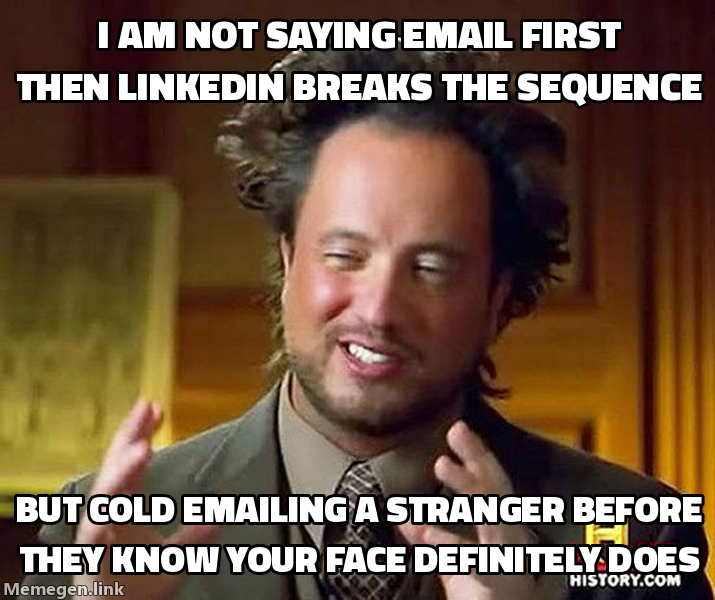 LinkedIn first. Email second. Recognition turns a cold email into a warm one.
The Core Sequence: Day by Day
A reliable multichannel sequence for a ten-to-fourteen day window looks like this:
Day 1: View the prospect’s LinkedIn profile. No message. The notification is the touch.
Day 3: Send a connection request. Keep the note under 200 characters if you include one. Something like “Saw your work on [specific thing], thought it made sense to connect” outperforms a pitch.
Day 5: First cold email. Subject line under six words. Body under ninety words. One clear ask. Reference the industry or role, not fake personalization.
Day 8: LinkedIn direct message (if connected) or a follow-up email (if not). Change the angle. If the first email led with the problem, the follow-up can lead with a social proof angle or a different outcome you deliver.
Day 12: Final email or LinkedIn DM. Keep it short: “Happy to close the loop if the timing is off. Worth a quick call?” A low-pressure close outperforms a repeated pitch.
For a deeper look at structuring cold email steps within this sequence, see our guide on done-for-you cold email and how we run these sequences at scale.
Signal-Based Triggering: When to Launch the Sequence
The biggest lever in multichannel outbound is not the copy. It is timing. Launching a sequence the week a prospect posts about hiring, raises a round, or launches a new product line multiplies reply rates without any change to the message itself.
Signals worth tracking:
- Job change (prospect moved to a new company or new role in the last ninety days)
- LinkedIn post activity (they are active and engaged, not dormant)
- Company funding, expansion, or product launch
- A competitor you displaced (or that just lost a customer)
Clay is the most practical tool for connecting these signals to your sequences automatically. You can also do this manually for smaller lists. The principle is the same: launch the sequence when the prospect has a reason to care, not on a rigid calendar schedule.
We cover signal-based triggering in more depth in our clay enrichment service and managed outbound service pages.
LinkedIn Outreach Rules That Keep Your Account Safe
LinkedIn is protective of user experience and will restrict accounts that send high volumes of generic messages. A few rules that keep you safe:
Use a weekly connection request volume that grows gradually. Starting at thirty per week and scaling to one hundred over four to six weeks is safer than sending one hundred from day one.
Personalize at least the first message field even if the rest of the sequence is templated. Accounts that send identical messages at scale get flagged faster.
Withdraw connection requests that go unanswered after two to three weeks. A high pending-request count is a soft risk signal.
Mix in organic LinkedIn activity (commenting, posting) so your account looks like a real person and not an automation tool.
For teams that want LinkedIn outreach fully managed without account risk, see our heyreach agency page.
Measuring What Works
Three numbers matter for multichannel:
Connection acceptance rate (a healthy rate signals good targeting and a compelling note). If it is low, the targeting or the connection note needs work, not the email.
Email open rate by day (track day five opens separately from day eight). A drop between day five and day eight tells you the first email is not landing, not that the sequence is broken.
Reply-to-meeting conversion. Some replies are nos. Track how many positive replies actually convert to a calendar invite. A high reply rate with low conversion usually means the offer or the ICP is off, not the sequence.
If you are comparing tools to run this workflow, our smartlead agency and lemlist agency pages cover the tradeoffs in platform selection.
Running This Without an Internal Team
Most founders and sales leaders cannot dedicate the hours needed to build, monitor, and iterate a multichannel sequence. The targeting needs to be refreshed weekly, the copy needs A/B testing, and the deliverability setup (custom domains, warm-up, SPF/DKIM/DMARC) needs maintenance.
Asphia builds and runs this infrastructure for B2B teams across Europe and beyond. Outbound we run has booked meetings with teams at companies across several markets. The system is built in your stack and yours to keep. See our outbound engine builder page for how the build process works, or services for a full overview.
Get the signal tier list in your inbox.
We rank signals from S to D to decide who gets a cold email and who does not. You get the list once. No follow-up emails.
Request received. The list lands in your inbox within 24 hours.
One more step: send the prepared request to [email protected]
FAQ
What is linkedin and email multichannel outbound?
It is a coordinated prospecting approach where LinkedIn touches (profile views, connection requests, direct messages) and cold emails run on a shared sequence timeline. Each channel reinforces the other so the prospect sees your name more than once before you ask for a meeting.
How many touches does a good multichannel sequence need?
Most sequences that work well run between three and six touches spread over ten to eighteen days. Front-load LinkedIn to build recognition, then switch to email for the direct ask. More touches are fine if you vary the angle and keep messages short.
Does multichannel outbound hurt deliverability?
No, the two channels are independent. LinkedIn activity has zero effect on email inbox placement. If anything, multichannel helps: a warmed prospect is less likely to mark your email as spam, which protects your sender reputation over time.
Should I send the connection request before or after the first email?
Before. Send the connection request (without a note, or with a very short one) two to four days before the first email. By the time the email arrives the prospect has already seen your name and face, which meaningfully raises open and reply rates.
What tools do I need to run multichannel outbound?
At minimum you need a LinkedIn automation tool for sequencing (HeyReach, GetSales, or Expandi), a cold email platform (Smartlead, Lemlist, or Instantly), and an enrichment layer such as Clay or Apollo to sync data across both. A shared CRM or a spreadsheet-based tracker is enough to start.
Is multichannel outbound GDPR compliant?
It can be. Legitimate interest is the most commonly used legal basis for B2B outreach in the EU. Keep records of your targeting criteria, honor opt-outs immediately across both channels, and never use scraped personal data beyond its intended purpose. Working with a GDPR-native agency removes most of the compliance burden.

Ahmet Faruk Yilmaz
Founder of Asphia. He builds and runs signal-based B2B outbound engines for lean teams, and has booked meetings with teams at companies across five markets. Writes about cold email, Clay, deliverability, and GTM engineering.
Want this run for you?
Get a free GTM analysis. We show you the exact engine we would build.
Get your free GTM analysis →