LinkedIn Connection Request Acceptance Rate Benchmarks for B2B Outreach
June 9, 2026 · 5 min read · by Ahmet Faruk Yilmaz, Founder of Asphia
TL;DR
A realistic LinkedIn connection request acceptance rate in B2B outreach is commonly cited as 20 to 35 percent for cold sends. Signal-based outreach (job changes, content engagement, shared groups) tends to push that toward 40 to 55 percent. Anything above 50 percent cold is generally considered exceptional. Anything below 15 percent typically means targeting, profile quality, or send volume is off.
LinkedIn connection request acceptance rate is the first number that determines whether your entire LinkedIn outreach strategy lives or dies. Before anyone sees your message, before anyone books a call, they have to accept.
The short answer: cold B2B outreach is typically cited as landing between 20 and 35 percent acceptance. Signal-based outreach (targeting people around a trigger event) tends to reach 40 to 55 percent. Below 15 percent generally indicates something fundamental is broken.
What the Benchmarks Actually Mean
Acceptance rate does not exist in a vacuum. A 25% acceptance rate from a tightly defined ICP (say, VP of Sales at 50-200 person SaaS companies in the Netherlands) is worth far more than a 40% rate from a broad spray across three industries and six job titles.
The benchmark you should care about is acceptance rate multiplied by quality of the people accepting. A senior decision-maker who accepts and then books a call is categorically different from a junior professional who accepted because they accept everyone.
That said, here are working benchmarks broken down by outreach type:
Cold, no personalization, no signal: typically 10 to 20 percent Cold with a relevant note or clear context: commonly cited as 20 to 30 percent Signal-based (recent job change, funding, content engagement): tends to land around 35 to 55 percent Warm (mutual connection, event, shared community): generally considered 50 to 70 percent
These are directional industry ranges. Your specific numbers will shift based on your industry, the seniority of your targets, your profile authority, and whether LinkedIn has flagged your activity.
What Actually Moves Acceptance Rate
Three variables drive the most movement. Optimizing in order:
1. Your profile. This is the most underestimated lever. When someone receives a connection request, the first thing they do is look at your profile photo, headline, and first line of the About section. A photo that looks like a stock image, a headline that reads “Helping companies 10x their pipeline” with no specifics, and a summary that opens with “I’m passionate about sales” all reduce acceptance. A specific headline, a real photo, and a clear statement of what you actually do for what kind of company changes this more than any message tactic.
2. Who you are targeting. The more specific and relevant your ICP, the higher your acceptance rate, because people recognize they belong in your network for a real reason. If you are reaching out to heads of operations at PE-backed professional services firms and your background is in operational consulting, there is a natural reason to connect. If you are reaching out to that same group but you run a generic marketing agency, the mismatch is visible.
3. Signal relevance. Reaching out within a week of a job change, a funding announcement, a post they published, or a trigger event that directly relates to what you offer creates a plausible reason to connect without stating it explicitly. This is the core of signal-based outreach and the reason it consistently outperforms static list pulls from tools like Apollo.
Note or No Note: The Honest Answer
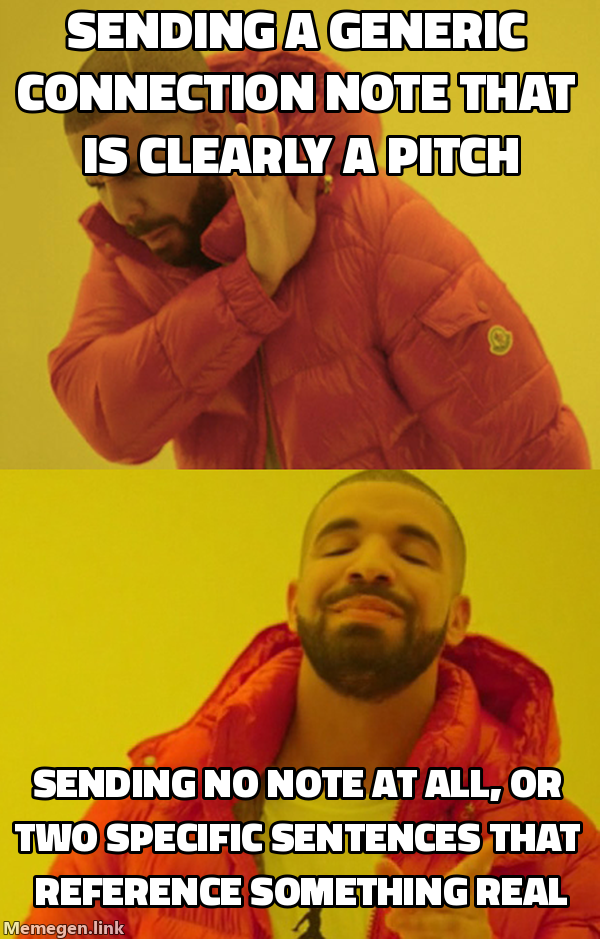 A blank request beats a hollow pitch every time. A real two-sentence note beats both.
There is no universal answer, but the evidence points in a consistent direction: a blank request beats a generic note, and a specific note beats a blank request.
The failure mode most teams fall into is writing a note that is clearly a pitch disguised as a greeting. “I’d love to connect and share how we help companies like yours with outbound” is not a reason to connect. It is a reason to decline.
A note that works has three characteristics. It is short (two sentences maximum). It references something real and specific (their content, their company’s situation, a shared context). And it asks for nothing.
If you cannot write a two-sentence note that meets those criteria for a given prospect, the blank request is probably the better choice.
Connection Rate Is a Gate, Not the Goal
Acceptance rate matters because it is the gate to your messaging sequence. A 20 percent acceptance rate on 100 weekly requests means 20 people enter your funnel. A 40 percent rate, with the same 100 requests, means 40 people. That is a doubling of pipeline without sending a single extra request.
But the trap is optimizing acceptance rate by lowering the quality bar for who you target. A 60 percent acceptance rate from anyone who clicks accept is not the same as a 30 percent rate from decision-makers at companies you can actually close.
The full LinkedIn funnel runs: connection request sent, accepted, first message opened, replied to, meeting booked. Each step has a conversion rate, and each one is worth knowing. See how managed LinkedIn outreach works at Asphia.
What to Do If Your Rate Is Below 15%
Below 15% on a consistent basis usually points to one of four problems:
First, profile issues. Check your photo, headline, and About section against someone your targets would genuinely want to connect with in your space.
Second, targeting too broadly. Run your ICP through a tighter filter. Fewer, more relevant requests outperform high-volume broad sends at almost every stage.
Third, LinkedIn activity flags. If you have used automation in ways that violated LinkedIn’s terms, your account may be in a restricted state that reduces visibility of your requests. Reducing send volume and operating manually for a period often helps.
Fourth, no logical reason to connect. If your background and your targets have nothing in common, there is no implicit reason for them to accept. The fix is either tightening your niche or adding a note that creates context.
If you want to see how we build signal-based LinkedIn sequences that consistently land above cold benchmarks, our done-for-you outbound service includes full LinkedIn sequence setup alongside cold email, with human review on every message before it sends.
Get the signal tier list in your inbox.
We rank signals from S to D to decide who gets a cold email and who does not. You get the list once. No follow-up emails.
Request received. The list lands in your inbox within 24 hours.
One more step: send the prepared request to [email protected]
FAQ
What is a good LinkedIn connection request acceptance rate?
For cold B2B outreach, 20 to 35 percent is a commonly cited benchmark. If you are targeting based on a recent signal (job change, funding round, content engagement), 40 to 55 percent is generally considered achievable. Below 15 percent typically points to a weak profile, over-broad targeting, or sending too many requests too fast.
Does adding a note to a LinkedIn connection request help?
It depends. Short, specific, non-salesy notes tied to a real reason (you read their post, you share a target market) can lift acceptance by a meaningful margin. Generic notes like 'I'd love to connect' often hurt more than a blank request because they signal spam.
How many LinkedIn connection requests can I send per week without getting restricted?
LinkedIn's public guidance is vague, but practitioners report that staying under 100 requests per week is the safest ceiling for standard accounts. Sales Navigator accounts have higher limits. Sending in bursts or using automation that mimics inhuman speed triggers restrictions faster than volume alone.
Why is my LinkedIn acceptance rate dropping?
Common causes include profile photos that look generic, headlines that read as 'SDR seeking quota,' sending to audiences with no clear signal connecting you to them, and using automation that LinkedIn's detection has flagged. Review your profile, tighten your ICP, and reduce weekly volume to reset.
Should I send LinkedIn connection requests without a note?
Many practitioners find blank requests outperform generic notes, especially for senior buyers who receive dozens of pitches per week. The exception is when you have a specific, honest reason to connect (a post they wrote, a mutual connection, a trigger event). Specificity beats a blank request; a generic note does not.
How does acceptance rate affect the rest of my LinkedIn outreach funnel?
Acceptance rate is the gate to everything else. A 20 percent acceptance rate on 100 requests gives you 20 people who can now receive your first message. Doubling acceptance to 40 percent doubles your reachable pool without sending a single extra message, making it the highest-leverage metric in the LinkedIn funnel.

Ahmet Faruk Yilmaz
Founder of Asphia. He builds and runs signal-based B2B outbound engines for lean teams, and has booked meetings with teams at companies across five markets. Writes about cold email, Clay, deliverability, and GTM engineering.
Want this run for you?
Get a free GTM analysis. We show you the exact engine we would build.
Get your free GTM analysis →