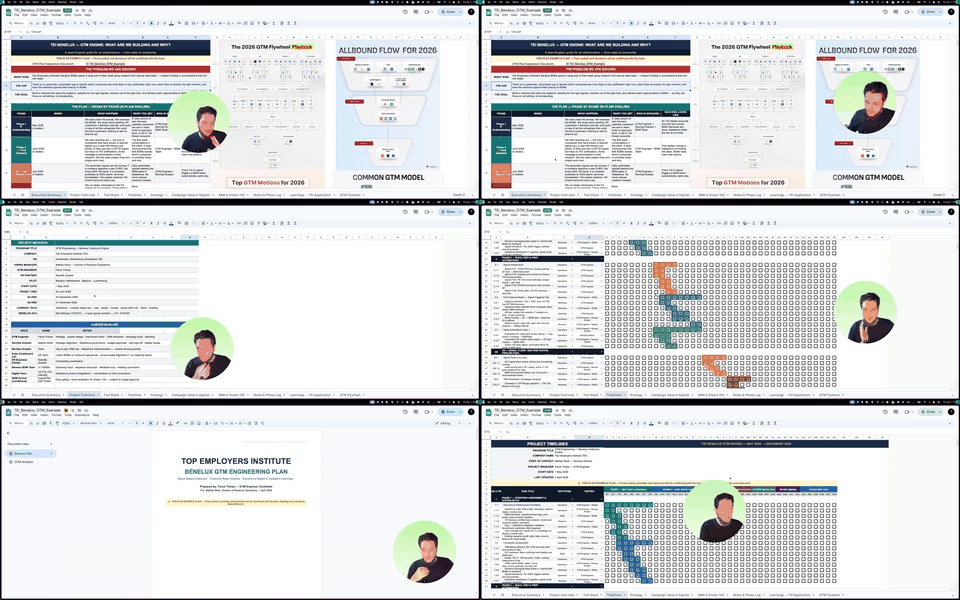
Tech Stack Change as a Sales Trigger: How to Spot It and Write Copy Around It
April 11, 2026 · 6 min read · by Ahmet Faruk Yilmaz, Founder of Asphia
TL;DR
A tech stack change tells you a company is actively solving a problem, has budget moving, and is in a decision window. Spot it via job posts, LinkedIn activity, or data providers like Apollo. Write copy that names the tool, connects it to a pain, and offers a specific next step.
A company switching CRMs, adding a new marketing automation platform, or migrating off a legacy data warehouse is not just an IT event. It is a buying window. The tech stack change outbound trigger works because it tells you three things at once: there is an active problem being solved, budget has been approved, and someone inside is accountable for the outcome.
That accountability is your entry point.
Why Tech Stack Signals Beat Generic Trigger Lists
Most outbound lists are built on firmographic criteria: industry, headcount, revenue range. Those filters narrow the universe but they tell you nothing about timing. A company matching your ICP perfectly is still a cold prospect if no one inside is actively thinking about the problem you solve.
A tech stack change changes that equation. When a company adopts Salesforce, they now have a CRM administration problem. When they add HubSpot on top of Salesforce, they almost certainly have a data sync problem. When they drop Outreach for Apollo, someone decided the old motion was not working and a new one needs to be built.
Each of these transitions creates a window, typically measured in weeks, where the team is simultaneously excited about what the new tool promises and anxious about what it will take to actually deliver. That anxiety is your opening.
If you are running signal-based cold email or working with a clay enrichment service, tech stack signals are one of the highest-converting triggers you can layer into a campaign.
 The window is four weeks. Your monitoring cadence determines whether you catch it.
How to Source Tech Stack Change Signals
You do not need a large data budget to get started. Here are the most reliable sources, roughly ordered by signal freshness.
Job descriptions. A company posting a “Salesforce Administrator” role three months after previously having none is a strong signal of recent adoption. A job post mentioning HubSpot workflows, Apollo sequences, or Snowflake pipelines tells you exactly what stack they are building. LinkedIn job search lets you filter by company, keyword, and date posted.
LinkedIn activity. Champions post about new tool rollouts, certifications, and implementation milestones. A “just passed my HubSpot certification” post from a RevOps manager is a real-time signal. Saves it takes no tooling to catch.
BuiltWith and similar technology intelligence tools. These crawl the web to detect installed technologies (analytics scripts, ad pixels, chat widgets, CMS platforms). They are better for detecting current state than spotting changes, but month-over-month diffing is possible.
Apollo and intent data providers. Apollo surfaces technology data at the company level. Bombora and G2 Buyer Intent track when companies are researching specific software categories, which correlates strongly with evaluation and switching activity.
G2 reviews. A spike in reviews for a competitor or adjacent tool from employees at a target company is a soft signal of active evaluation. Low volume but high precision.
The goal is not to have every signal. It is to have one reliable signal per campaign and build copy tightly around that one thing.
How to Write Copy Around a Tech Stack Change
This is where most teams get it wrong. They reference the signal as a conversation opener (“I noticed you recently adopted X”) and then pivot immediately to a generic pitch. The prospect feels seen for one sentence and then forgotten.
Better approach: treat the stack change as the problem, not just the context.
Name the tool specifically. Not “I see you’re using a new CRM” but “I see you’re running Salesforce now.” Precision signals that you actually know what you’re talking about.
Connect it to a real downstream pain. Every significant tool adoption creates operational friction that takes weeks or months to surface. Salesforce rollouts often surface data hygiene problems. HubSpot-Salesforce integrations frequently create lead routing gaps. Apollo migrations often leave teams without a warm-up infrastructure for new sending domains. Pick the friction point that is most relevant to what you offer.
Make the outcome specific. Not “we help sales teams be more efficient” but “we’ve helped RevOps teams close the lead routing gap that usually appears in the first 60 days after a HubSpot-Salesforce sync goes live.”
Keep it short. A signal-based email should be two to four sentences in the body. The signal earns you attention. The specificity earns you a reply. The offer earns you a meeting.
For a deeper look at how copy structure affects reply rates, the done-with-you outbound approach walks through how Asphia builds these sequences inside your own stack.
Sequencing Around the Signal
A single email is rarely enough. A well-structured sequence around a tech stack trigger typically runs three to five touches over two to three weeks.
Touch one references the signal directly and leads with the pain it creates. Touch two offers a piece of evidence: a short case framing, a relevant observation, a tool or resource that is genuinely useful given the stack they just adopted. Touch three makes a direct ask, ideally a low-commitment next step rather than a full demo request.
LinkedIn touches between emails dramatically improve reply rates for this trigger type, because the person you are reaching out to is almost certainly active on LinkedIn given that the signal often comes from there.
If you want to see how this sequencing works across multiple channels without running it manually, managed outbound service is one option. If you want to build it yourself and own it permanently, outbound engine builder covers the build process end to end.
The GDPR Layer
Tech stack signals are business data, not personal data in the GDPR sense. The lawful basis for most B2B outbound using this kind of signal is legitimate interest. The test is whether the outreach is relevant to the recipient’s professional role and whether the data used relates to their business activity rather than their private life.
A RevOps manager at a company that just adopted Salesforce receiving an email about Salesforce data quality is relevant to their role. A personal email about their holiday plans would not be. The GDPR framework is clear on this distinction.
Document the legitimate interest basis at the campaign level. Include a one-click opt-out in every email. Do not buy lists that mix personal and business data without a clear provenance. These three steps cover the vast majority of B2B signal-based outbound under EU law.
If you are building outbound for European markets and want to make sure the infrastructure is GDPR-native from the start, GDPR-compliant cold email agency covers how Asphia approaches this for campaigns across TR, EN, NL, DE, and AR markets.
Get the signal tier list in your inbox.
We rank signals from S to D to decide who gets a cold email and who does not. You get the list once. No follow-up emails.
Request received. The list lands in your inbox within 24 hours.
One more step: send the prepared request to [email protected]
FAQ
What is a tech stack change signal in B2B outbound?
It is a detectable event showing a company has adopted, dropped, or evaluated a new software tool. It indicates active problem-solving, recent budget approval, and a decision window, making the company far more receptive to outbound than an account with no visible activity.
How do you find tech stack change signals at scale?
Use tools like Apollo, Bombora, or BuiltWith to track technology adoption. Job descriptions mentioning specific platforms, LinkedIn posts from champions, and G2 review spikes are free signals you can layer on top of paid data.
What should cold email copy say when referencing a tech stack change?
Name the specific tool, connect it to a real operational pain that adoption typically surfaces, and offer one concrete outcome. Avoid generic congratulations. Write as if you already work in that stack and know exactly where friction appears after onboarding.
Is using tech stack data for cold email GDPR compliant?
Legitimate interest is the most common basis. The key tests are: the data is business-related (not personal), the outreach is relevant to the recipient's professional role, and you provide a clear opt-out. A GDPR-native outbound process documents this basis at the campaign level. See gdpr.eu for the full legitimate interest framework.
How soon after a tech stack change should you reach out?
Within four to six weeks of the signal is typically the sweet spot. Too early and the team is still in implementation chaos. Too late and the problem you could solve has already been patched or the budget cycle has closed.
Can small outbound teams use tech stack triggers without Clay or expensive data?
Yes. Free signals include job posts on LinkedIn (search for the tool name plus the company), the company's own blog or changelog, and G2 reviews. Layer in one enrichment tool and you have a workable signal stack without a large data budget.

Ahmet Faruk Yilmaz
Founder of Asphia. He builds and runs signal-based B2B outbound engines for lean teams, and has booked meetings with teams at companies across five markets. Writes about cold email, Clay, deliverability, and GTM engineering.
Want this run for you?
Get a free GTM analysis. We show you the exact engine we would build.
Get your free GTM analysis →