Cold Email for Cybersecurity Companies: How to Reach CISOs and IT Decision-Makers
May 18, 2026 · 4 min read · by Ahmet Faruk Yilmaz, Founder of Asphia
TL;DR
Inbox placement and relevance determine whether cybersecurity cold email works. Lead with a specific threat signal, target the right role, keep the copy short, and protect deliverability.
CISOs and IT decision-makers understand risk, know every inbox trick, and distrust vendor outreach. Generic cold email gets ignored. A message tied to a specific signal can still get their attention.
Cold email works here when you have a specific reason to write, match the message to the right person, and protect deliverability. Everything else is secondary.
Why Cybersecurity Cold Email Is Harder Than Most Verticals
Security buyers are trained to distrust incoming messages. A CISO who spent a decade teaching employees to spot phishing will not click a message that looks like every other vendor email from that week.
The relevance bar is high. You need a reason to be in their inbox, not a pitch deck summary. Usually, that reason is a recent breach or CVE affecting their industry, an approaching compliance deadline such as SOC 2, NIS2, DORA, or CMMC, or a stack change that creates a gap your product fills.
If you cannot point to a specific signal, you are not ready to send.
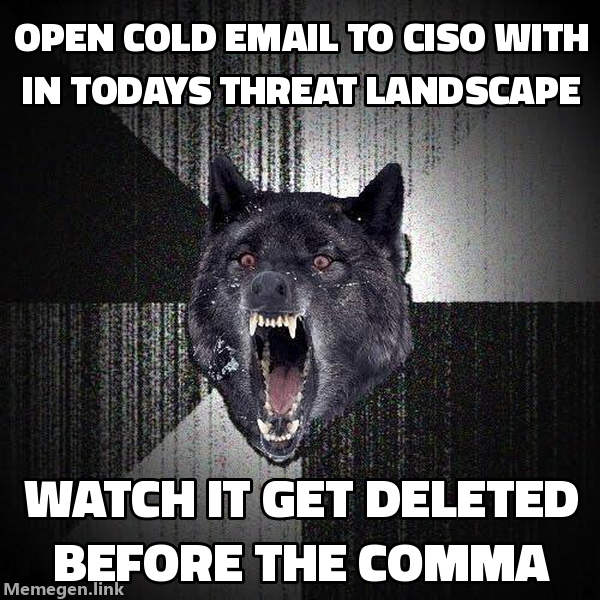 The CISO who trained employees to spot phishing is not impressed by vendor boilerplate.
How to Build the Right List
Start with job titles, then narrow the list by company profile. CISOs are most common at mid-market companies with 200 to 2000 employees and at enterprises. At smaller companies, look for IT Directors, Heads of Infrastructure, or sometimes the CTO.
Pull an initial list with Apollo or a similar tool. Then use Clay enrichment to add work emails and firmographic data. CISO-level addresses are often hard to find, so Clay’s ability to waterfall across several email providers matters.
Verify the list before sending. A bounce rate above one percent starts damaging sender reputation. Cybersecurity campaigns already run at lower volume, so each invalid address costs more than it would in a high-volume campaign.
Follow GDPR-compliant cold email practices from day one. Security buyers know the rules. A message without a clear opt-out, or one that uses personal data without a legitimate basis, gives them an immediate reason to dismiss you.
Writing Cold Email Copy That Security Buyers Actually Read
Cybersecurity cold email copy needs three things: a specific detail about the recipient’s situation, one clear claim about what you help with, and a small next step.
Do not use phrases such as “in today’s threat landscape,” “as attacks become more sophisticated,” or “your security posture.” They tell the buyer you do not know their actual problem.
Open with an approaching compliance requirement, a recent public incident at a similar company, or a technology they recently adopted that creates a known vulnerability class. Job postings and LinkedIn activity can reveal the last signal.
Keep the body under 100 words. CISOs read email on phones between meetings. Respect that constraint.
Make the call to action easy to answer. “Worth a 20-minute call this week?” beats “Would you like to schedule a demo of our full platform?” The first asks for time. The second asks for commitment before you have earned it.
Teams without dedicated outbound staff can use a done-with-you outbound model to set up the system, then run it themselves. This can suit cybersecurity vendors that need tight control over messaging for compliance or brand reasons.
Deliverability for Cybersecurity Senders
Security-conscious companies filter incoming email aggressively. A message sent to a CISO’s corporate inbox may pass through more layers than one sent to a typical B2B buyer.
Use dedicated sending domains, not your primary domain. Warm them up for three to four weeks before sending at real volume. Set up SPF, DKIM, and DMARC properly. Authenticate every mailbox.
Start with five to ten emails per mailbox per day for the first two weeks. Scale to thirty to forty over a month. Increasing volume too quickly is the most common reason a new domain lands in spam before the campaign produces results.
For outreach across several European markets, follow the public sender requirements from Gmail and Microsoft. Authentication and opt-out rules have become stricter. Meeting them is a basic requirement for inbox placement.
Sequences That Work for a Long Sales Cycle
Cybersecurity deals rarely close after one cold email. The buying cycle is long, involves several stakeholders, and often depends on a budget or renewal event. Build the sequence accordingly.
A four-step sequence over three weeks can include an initial email tied to a specific signal, a follow-up with a relevant case type or resource, a third touch with a different angle or stakeholder, and a breakup email that keeps the door open.
Add LinkedIn touchpoints without creating more inbox noise. Send a connection request after the first email or comment on one of the recipient’s posts.
Teams working across several personas and markets may use a managed outbound service, particularly when the content has strict compliance requirements.
Cybersecurity cold email is not a volume play. It depends on reaching the right inbox with relevant context at the right time.
Get the signal tier list in your inbox.
We rank signals from S to D to decide who gets a cold email and who does not. You get the list once. No follow-up emails.
Request received. The list lands in your inbox within 24 hours.
One more step: send the prepared request to [email protected]
FAQ
Can cybersecurity companies use cold email legally?
Yes. B2B cold email is legal under CAN-SPAM and GDPR when you email verified business addresses, include a clear opt-out, and have a legitimate interest basis. Cybersecurity vendors commonly reach IT and security buyers this way.
What subject lines work best when emailing CISOs?
Short, specific subject lines outperform clever ones. Reference the recipient's industry or a recent event, such as a relevant breach, compliance deadline, or tech stack change. Avoid phrases like 'security solution' and 'protect your business.' Spam filters and people both ignore them.
How do you find verified emails for CISOs and IT decision-makers?
Use Apollo or LinkedIn for discovery, a waterfall enrichment tool like Clay to find work emails, and a real-time verifier to remove invalid addresses before sending. This keeps bounce rates low and protects sender reputation.
How many follow-ups should a cybersecurity cold email sequence have?
Use three to four touchpoints over two to three weeks. Each follow-up should add a new angle or useful context. CISOs receive plenty of outreach, so 'just checking in' is not a reason to email again.
What mistakes kill cybersecurity cold email campaigns?
The biggest mistakes are sending from a primary domain without warm-up, using buzzword-heavy copy ('cutting-edge threat detection'), targeting all IT staff, and skipping list verification. Each one hurts deliverability or reply rate.
Should cybersecurity vendors use email or LinkedIn for outbound?
Both channels work, but they do different jobs. Cold email reaches passive buyers at scale. LinkedIn builds credibility and gives prospects another place to recognize you. Using both in one sequence produces better results than relying on either alone.

Ahmet Faruk Yilmaz
Founder of Asphia. He builds and runs signal-based B2B outbound engines for lean teams, and has booked meetings with teams at companies across five markets. Writes about cold email, Clay, deliverability, and GTM engineering.
Want this run for you?
Get a free GTM analysis. We show you the exact engine we would build.
Get your free GTM analysis →