Cold Email for Professional Services: Legal, Accounting, and Advisory Outreach That Converts
February 19, 2026 · 6 min read · by Ahmet Faruk Yilmaz, Founder of Asphia
TL;DR
Cold email works for professional services firms when each message opens with a signal about the prospect's situation, names a specific problem they recognise, and asks one low-friction question. Keep the body under 90 words, remove credentials entirely, and sequence three to four emails per contact over two weeks.
Cold email for professional services firms converts when it does one thing well: it makes the prospect feel seen before it asks for anything. Legal, accounting, and advisory outreach that leads with a specific observation about the reader’s situation consistently outperforms outreach that leads with the firm’s credentials.
The mechanics are the same across verticals. The angles are different.
Why Professional Services Cold Email Usually Fails
The default email from a law firm, accounting practice, or advisory firm sounds something like this: “We are a full-service advisory firm with over two decades of experience helping companies navigate complex challenges. Our team has worked across industries including financial services, technology, and manufacturing. Would you be open to a brief call?”
This email fails because it contains nothing the prospect cannot read on any competitor’s website. There is no signal that the sender has looked at this specific company, understood its current situation, or identified a problem worth discussing.
The prospect reads it as a mass campaign because it reads like one, even if it arrived as a single message.
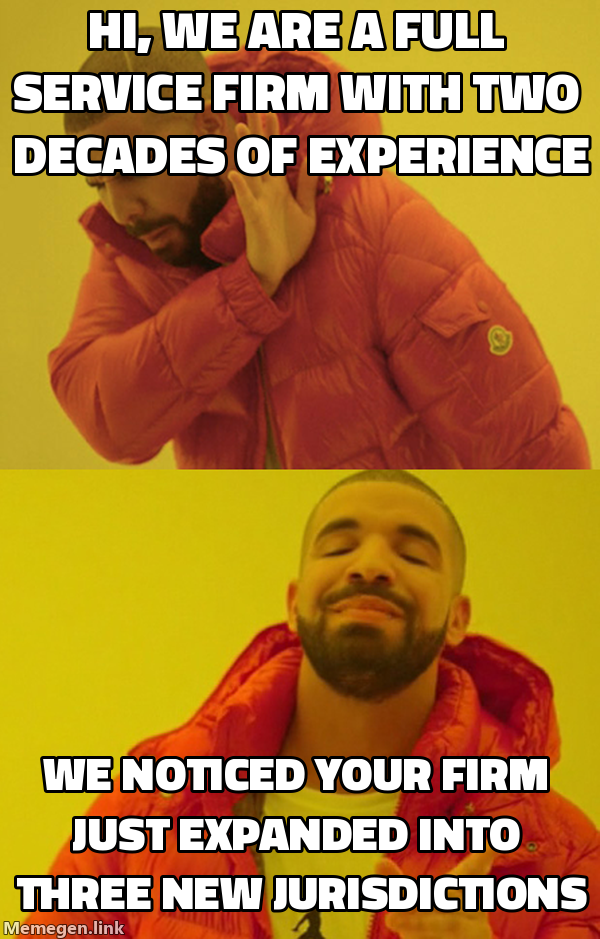 Your firm’s 20-year track record belongs on the website. The cold email gets one signal and one question.
The Structure That Books Meetings
A converting professional services cold email has four elements in this order:
- A specific, observable signal about the prospect’s world
- A problem that signal typically creates (that you solve)
- A brief statement of what you do about it
- One low-friction question, not a calendar link
The signal in the opening line carries most of the weight. It tells the prospect you have done real research. It also narrows the email from “sent to everyone” to “relevant to you specifically.”
For legal firms targeting general counsel: a signal might be a recent litigation filing, a regulatory change in the prospect’s sector, or a new market entry that creates contract complexity.
For accounting and tax advisory firms: hiring sprees, multi-jurisdiction expansion, recent M&A activity, or a CFO change are all observable triggers that create genuine accounting needs.
For management and strategy advisory firms: leadership transitions, strategy announcements in earnings calls, or a competitor move that puts pressure on the prospect’s position are high-relevance triggers.
Signal sourcing at scale is where most firms get stuck. Tools like Clay and Apollo make it possible to pull these signals across hundreds of contacts without manual research on each one. For firms that want this built properly, our clay enrichment service covers how signal-based lists are constructed.
Different Angles for Different Professional Services
Not every professional services cold email should use the same framing. The angle that works depends on the nature of the service and what typically triggers the need for it.
Legal firms tend to get the best results with risk-forward framing. An opening that names a visible regulatory shift or an emerging compliance gap creates urgency without being alarmist. Partners and general counsel respond to specificity because they live in a world of details.
Accounting and tax advisory firms do well with efficiency or exposure framing. Identifying a visible operational change that typically creates accounting complexity, or naming a tax exposure that commonly accompanies a specific corporate event, gives the prospect something concrete to evaluate.
Management consulting and strategy advisory firms often succeed with transition framing. Companies in growth, contraction, or change are already open to outside perspective. An email that names the transition and asks whether the firm has the internal bandwidth to manage it well lands differently than a general capability pitch.
Specialist advisory firms (cybersecurity, ESG, regulatory, or sector-specific) benefit from credibility-through-specificity. Naming the exact framework, regulation, or risk category signals expertise faster than any credential statement.
For a deeper look at how this works across verticals, our piece on outbound for professional services covers sequencing, targeting, and channel mix.
What to Cut Before You Send
Most professional services cold emails fail because of what they include, not what they leave out.
Cut the credentials paragraph. Years in business, named partners, firm size, and industry awards belong on your website and your proposals. A prospect receiving an unsolicited email cannot verify these claims and has no reason to care about them yet. Save credentials for the second conversation, when they are actually being evaluated.
Cut the methodology summary. A cold email is not a capabilities document. If you describe your approach in step-by-step detail in the opening email, you have given the prospect nothing to be curious about.
Cut invented numbers. Claims like “our clients see average cost reductions of 40 percent” or “we have completed over 500 engagements” without specific context reduce credibility rather than building it. A prospect who has seen fabricated social proof before, and most experienced buyers have, will discount everything that follows. Speak qualitatively when you cannot point to something specific and verifiable.
Cut the hard CTA. Asking for a 30 or 45 minute call in a first email is too much commitment before the prospect has decided you are relevant. A simple question like “Is this a challenge your team is working through right now?” reduces friction and invites a genuine response.
Deliverability and Compliance for Professional Services Outreach
Professional services firms have a reputational sensitivity that makes deliverability even more important than it is for other B2B categories. An email that lands in spam or triggers a complaint creates a visibility problem that goes beyond the campaign.
For firms targeting European clients, GDPR compliance is not optional. B2B cold email is generally permissible under legitimate interest when it is genuinely relevant to the recipient’s professional role and includes a clear opt-out in every message. For the authoritative source on what legitimate interest requires, the guidance at gdpr.eu is the starting point.
Technical setup matters too. Proper SPF, DKIM, and DMARC records, a warmed sending domain, and a managed sending volume all affect whether your emails arrive in the inbox. These are not one-time tasks. They require ongoing monitoring. Our GDPR-compliant cold email agency page covers how we build this for clients who want the infrastructure handled.
Running the System Without Adding Headcount
Professional services partners and firm leaders are not looking to become outbound marketers. The value of a structured outreach system is that it runs without demanding ongoing attention from people whose time is expensive.
The baseline system has three components: a signal-based contact list refreshed regularly, a short email sequence with angles tested across segments, and a clear handoff process so that positive replies reach the right person within hours.
Firms that want this built in their own stack rather than outsourced can use a done-with-you outbound model. Firms that want it fully managed can work with an agency. Either way, the machine is worth building once and keeping rather than running a new campaign every quarter from scratch.
The firms that consistently book meetings through cold email are not the ones writing the cleverest copy. They are the ones who have built a repeatable system and who have stopped sending emails that could have been sent by anyone to anyone.
Get the signal tier list in your inbox.
We rank signals from S to D to decide who gets a cold email and who does not. You get the list once. No follow-up emails.
Request received. The list lands in your inbox within 24 hours.
One more step: send the prepared request to [email protected]
FAQ
Can law firms and accounting firms legally send cold emails?
Yes, in most B2B contexts. In the EU and UK, cold email to business contacts at companies is generally permitted under legitimate interest when it is relevant to the recipient's professional role. Every message must include a clear opt-out. Consult GDPR guidance at gdpr.eu for specifics before launching.
What makes cold email hard for professional services firms?
The instinct to lead with credentials. Legal and accounting firms typically open with their history, accreditations, and service list. Prospects skip these because they apply to every firm in the category. The emails that convert open with the prospect's situation, not the sender's background.
How long should a cold email be for a professional services firm?
Aim for 60 to 90 words in the body. Longer emails signal that the sender values their own story over the reader's time. One signal, one problem, one question is the minimum viable structure. Everything else can go on your website.
What signals should professional services firms use to personalise outreach?
Hiring activity, leadership changes, recent funding or M&A, regulatory filings, expansion into new markets, and job posts that reveal internal pain points. These are all publicly available and give you a genuine reason to reach out rather than a fabricated one.
How many emails should be in a cold outreach sequence for advisory firms?
Three to four emails over two weeks is a reliable default. Email one is signal-based. Email two takes a different angle or raises a related risk. Email three is a brief follow-up. Email four closes the loop gracefully. Each email should stand alone so a prospect reading only the third one still understands the relevance.
Should professional services firms use cold email or LinkedIn outreach?
Both, used together. Cold email reaches decision-makers who do not check LinkedIn daily. LinkedIn touchpoints build familiarity before or after an email lands. The strongest sequences combine a LinkedIn connection request with a short email sequence, not one or the other.

Ahmet Faruk Yilmaz
Founder of Asphia. He builds and runs signal-based B2B outbound engines for lean teams, and has booked meetings with teams at companies across five markets. Writes about cold email, Clay, deliverability, and GTM engineering.
Want this run for you?
Get a free GTM analysis. We show you the exact engine we would build.
Get your free GTM analysis →