Best Email Warm-Up Tools in 2026: Smartlead vs Instantly vs Mailreach
August 5, 2025 · 5 min read · by Ahmet Faruk Yilmaz, Founder of Asphia
TL;DR
Smartlead and Instantly include solid built-in warmup that covers most senders. Mailreach wins if you want dedicated warmup with deeper inbox placement reporting. For agencies running many domains, the difference between tools matters less than warming slowly and rotating carefully.
Short answer: if you are already on Smartlead or Instantly, their built-in warmup is good enough for most cold outbound. If you need independent inbox placement reporting or you manage domains across many clients, a dedicated tool like Mailreach adds genuine value.
Email warmup is one of those things that sounds technical but has a simple job: convince inbox providers (Google, Microsoft, and others) that a new sending domain belongs to a real business sending legitimate mail. You do that by gradually increasing volume, generating positive engagement signals, and giving the domain time to build a reputation. The tool you use to do this matters less than the discipline with which you run it.
What email warm-up actually does
When you register a new domain and connect it to a mailbox, inbox providers have no history on it. A brand-new domain sending 200 emails on day one is a classic spam pattern. Warm-up tools solve this by sending a low volume of emails between a pool of real or semi-real accounts, which reply to each other, mark messages as important, and move them out of spam. Over several weeks, the sending domain earns a track record that makes high-volume outbound land in the primary inbox instead of promotions or spam.
The key variables are ramp speed (how fast you increase daily volume), engagement signals (reply rates within the warm-up network), and time. Every tool on this list manages those variables for you. Where they differ is in reporting, multi-domain handling, and how closely the warm-up integrates with your actual sending.
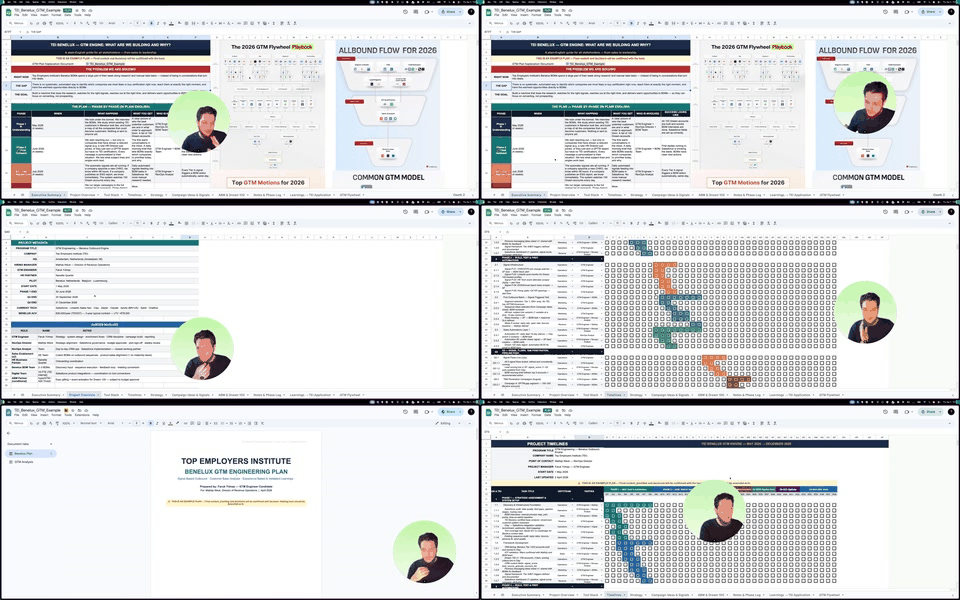
 Picked the right warmup tool though.
Smartlead: best for agencies running many domains
Smartlead includes warmup as part of every plan. You connect a mailbox, enable warmup, set a ramp schedule, and it runs in the background while your live campaigns run from the same platform. The main advantage is that everything lives in one place: your warmed mailbox is the same one sending your sequences, which means the reputation built during warmup carries directly into your campaign.
For agencies managing dozens of client domains, Smartlead’s centralized mailbox management is a real time saver. You can see warmup status across all accounts without jumping between tools. The reporting is functional rather than detailed: you know whether warming is running and roughly how many interactions are happening, but you do not get granular inbox placement breakdowns by provider.
If you are already on Smartlead for your cold outbound, there is no strong reason to add a separate warmup tool unless you want a second opinion on inbox placement. See also our breakdown of Smartlead vs Lemlist for a broader platform comparison.
Instantly: cleanest all-in-one experience
Instantly takes a similar approach: warmup is built in, connected to the same mailbox you send from, and configured through a simple interface. The warmup pool is large, which means your domain interacts with a diverse set of accounts rather than a small closed network. This matters because inbox providers can eventually identify warmup traffic patterns from small pools.
Instantly’s UI is more polished than Smartlead’s for teams that are newer to cold outbound. The tradeoff is that it gives you less raw control over sending behavior at scale. For solo founders, small sales teams, or consultants sending under a few hundred emails per day, Instantly is arguably the most approachable option. For a deeper comparison, our Instantly vs Smartlead post covers the platform tradeoffs in detail.
Mailreach: best for independent inbox placement data
Mailreach is a dedicated warmup and inbox placement testing tool. It is not a sending platform. You connect your mailbox, it warms the domain, and it shows you where your emails land across a range of real accounts at Gmail, Outlook, and other providers. That inbox placement reporting is the thing that separates Mailreach from built-in warmup.
The practical value: if you set up a new domain, warm it for three weeks on Smartlead, and then send a test through Mailreach, you get actual data showing whether your emails land in the primary inbox, promotions tab, or spam for different providers. That feedback loop is difficult to get from a tool that only tells you warmup is running.
For agencies building cold email infrastructure for clients, or for any team that needs to verify inbox placement before going live, Mailreach earns its place in the stack even if you already use built-in warmup elsewhere.
What matters more than the tool
The warmup tool is not the bottleneck for most senders who are hitting spam. The more common causes are sending to unverified lists (bounces above roughly 2 percent damage reputation fast), missing or misconfigured DNS records (SPF, DKIM, DMARC), copy that triggers spam filters, and sending too many emails too fast from a domain that is still building reputation.
If you are running AI-assisted cold email at any real volume, the infrastructure layer matters more than which warmup tool you pick. Domain age, list hygiene, sending cadence, and copy quality determine whether you land in the inbox. Warmup creates the conditions for that to work. It does not override the fundamentals.
Google and Microsoft both publish sender guidelines that are worth reading before you configure any new sending domain. Their requirements around DMARC and list hygiene are not optional at any meaningful send volume.
How to choose
Use Smartlead or Instantly built-in warmup if you are already on those platforms and sending under a few hundred emails per day per domain. Add Mailreach or a similar placement testing tool if you manage many domains, work with clients who need verification data, or want a second opinion before going live with a new campaign.
If you are building outbound from scratch and want the infrastructure handled for you, the done-for-you cold email path includes domain setup, warmup, and ongoing deliverability management as part of the engagement.
Get the signal tier list in your inbox.
We rank signals from S to D to decide who gets a cold email and who does not. You get the list once. No follow-up emails.
Request received. The list lands in your inbox within 24 hours.
One more step: send the prepared request to [email protected]
FAQ
What are the best email warm-up tools in 2026?
Smartlead and Instantly both include built-in warmup that handles most cold outbound needs. Mailreach is the strongest standalone option if you want detailed inbox placement data. The right choice depends on whether you are warming one domain or managing many at once.
How long does email warm-up take?
Plan for at least three to four weeks before sending high volumes from a new domain. Start with 5 to 10 emails per day and increase gradually. Rushing warmup is the single most common reason cold email campaigns hit spam.
Do I need a separate warm-up tool or does my sending platform include it?
Smartlead, Instantly, and most modern cold email platforms include warmup as part of the subscription. A separate tool like Mailreach or Lemwarm makes sense when you want independent verification of inbox placement or when you manage many domains across different senders.
Does email warm-up actually improve deliverability?
Yes, but it is not a fix for bad fundamentals. Warmup builds sending reputation gradually so inbox providers trust a new domain. It does not compensate for sending to invalid addresses, missing DMARC records, or spammy copy. Warmup is the starting point, not the whole strategy.
Can I warm up multiple domains at the same time?
Yes. Smartlead and Instantly are built for this and let you warm dozens of domains in parallel with separate schedules per mailbox. Standalone tools like Mailreach also support multi-domain warming, which is critical for agencies or teams running campaigns across multiple sending identities.
Is email warm-up compliant with GDPR?
Warmup itself does not involve personal data. The emails go between a network of real or semi-real accounts managed by the tool provider. GDPR applies to your actual cold outbound (real recipients, real data). Your DNS setup, unsubscribe handling, and data sourcing are the GDPR-relevant pieces, not the warmup phase.

Ahmet Faruk Yilmaz
Founder of Asphia. He builds and runs signal-based B2B outbound engines for lean teams, and has booked meetings with teams at companies across five markets. Writes about cold email, Clay, deliverability, and GTM engineering.
Want this run for you?
Get a free GTM analysis. We show you the exact engine we would build.
Get your free GTM analysis →