Cold Email Copywriting for German Prospects: Tone, Formality, and Response-Rate Patterns
March 18, 2026 · 4 min read · by Ahmet Faruk Yilmaz, Founder of Asphia
TL;DR
German prospects respond better to formal address (Sie), precise value claims, and short subject lines that respect their time. Skip the casual US-style opener. Lead with a concrete business problem, use proper German professional norms even when writing in English, and ensure DSGVO-compliant opt-out is visible.
German B2B prospects are among the hardest cold email audiences to crack, and the gap is almost never the offer. It is the copy. The casual, first-name, emoji-laced formats that move the needle in US or UK markets actively harm reply rates in the DACH region.
The short answer: write formally, be specific, respect their time, and make your relevance obvious in the first sentence.
The Formality Layer Is Not Optional
German professional communication defaults to formal register. This applies to cold email even when you write in English. The norms carry over.
In German-language emails, use “Sehr geehrte/r Herr/Frau [Nachname]” as the opener. Never start with the first name alone on a cold touch. In English emails to German contacts, “Dear Mr. [Surname]” or “Dear [Full Name]” reads as professional. “Hey Thomas” does not, regardless of how well the email is written otherwise.
The “Sie” versus “du” choice matters enormously in German copy. Default to Sie. Du signals familiarity that has not been earned and reads as presumptuous rather than friendly. Some startups and tech companies use du internally, but you cannot know that on a cold reach, and the cost of getting it wrong far exceeds the marginal warmth.
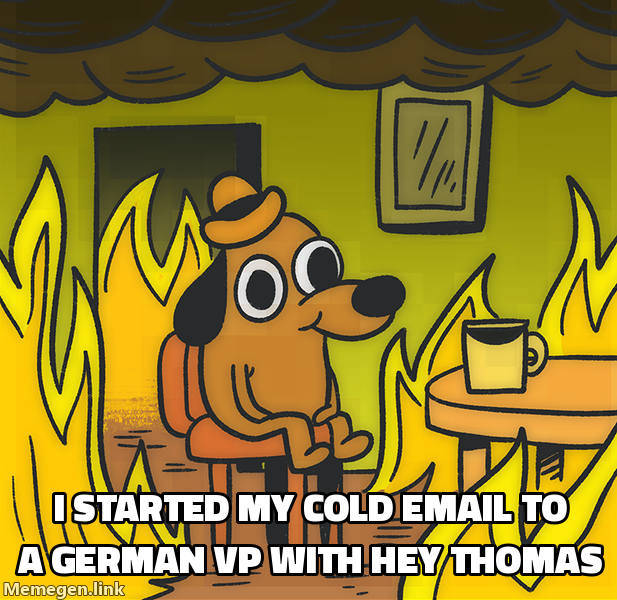 “Hey Thomas” to a cold German contact. This is fine.
Subject Lines: Literal, Not Clever
The US cold email playbook loves pattern-interrupt subject lines: curiosity gaps, provocative questions, one-word openers. These perform poorly with German audiences.
German professionals value directness and clarity. A subject line that obscures the email’s purpose is read as manipulative rather than intriguing. Patterns that consistently perform better include:
- A specific referral (“Weiterempfehlung von [Name]”)
- A plain topical statement (“Outreach-Prozess bei [Firmenname]”)
- A short, genuine question (“Kurze Frage zu Ihrem Vertrieb”)
Keep subject lines under seven words. Avoid exclamation marks, urgency phrases, and anything that looks like a sales push. German inboxes are also high-volume. The subject line wins attention by appearing relevant and professional, not by appearing urgent.
Copy Structure: Problem Before Solution
German decision-makers are operationally focused. They want to know immediately why this email landed in their inbox and what specific problem it addresses. The “build rapport, then pitch” arc common in US email sequences wastes words that German readers do not grant you.
A structure that works:
- One sentence on why you are writing (trigger, referral, or relevant context).
- One to two sentences on the specific problem your offer addresses, framed to their industry or company type.
- One low-friction call to action, ideally a single yes-or-no question.
Avoid: lengthy company introductions, lists of client logos, benefit lists that run past three items, and phrases like “I hope this email finds you well” (widely understood as filler in German business culture).
The done-for-you cold email approach we run for clients includes a German-language review step before any email goes out to DACH contacts. The tone shift between a translated US email and a properly localised German email is significant enough to change reply rates meaningfully.
DSGVO and Opt-Out: Non-Negotiable
Any cold email reaching German or EU-based contacts must be DSGVO-compliant (GDPR in German law). For B2B email to work addresses, legitimate interest is a recognised legal basis, but it requires:
- A clear, specific business reason for contact
- An easy, visible opt-out mechanism in every email
- No personal email addresses in scope
This is not optional and it is not a technicality. German recipients are more likely than most European audiences to exercise GDPR rights and to report non-compliant senders. Building compliance into the copy and the sending infrastructure from day one protects deliverability and your sender reputation.
Our GDPR-compliant cold email agency page covers how we structure opt-out, data handling, and legitimate interest framing across EU markets including Germany.
Personalization That Actually Works in the German Context
Generic personalization (“I saw you went to [University]”) lands awkwardly in German professional contexts. The signals that earn attention are industry-specific and operationally relevant.
Strong personalization hooks for DACH prospects:
- A recent hire, expansion, or product announcement (signals growth phase)
- An industry-specific challenge common in their vertical (manufacturing supply chain, SaaS churn, logistics cost pressure)
- A specific operational detail visible from their public presence (job listings signal internal priorities, for example)
Shallow personalization is visible and counterproductive. If the signal is not genuinely relevant, omit it and lead with a sharp problem framing instead. German readers respect precision over performed warmth.
For companies building outbound into the German market, the full infrastructure matters as much as the copy. See our outbound lead generation Germany overview for how we approach list building, localisation, and sequencing for DACH campaigns.
Get the signal tier list in your inbox.
We rank signals from S to D to decide who gets a cold email and who does not. You get the list once. No follow-up emails.
Request received. The list lands in your inbox within 24 hours.
One more step: send the prepared request to [email protected]
FAQ
Should I write cold emails to German prospects in German or English?
It depends on seniority and industry. Senior decision-makers at international tech or SaaS companies usually accept English. Mid-market manufacturing or Mittelstand contacts convert better in German. When in doubt, send in German with a professional translator or a native reviewer. Machine translation is detectable and kills credibility.
Is cold email legal in Germany under DSGVO?
B2B cold email to work email addresses is permitted under legitimate interest provisions, provided you have a genuine business reason, offer an easy opt-out, and do not email personal addresses. Always include an unsubscribe mechanism. For more detail, see our page on GDPR-compliant outbound.
What subject lines work best for German B2B cold email?
Short, literal, and non-gimmicky. German professionals distrust clickbait. Effective patterns include a direct question ('Frage zu [Thema]'), a specific referral hook ('Empfohlen von [Name]'), or a plain statement of relevance ('Outbound-Prozess bei [Firmenname]'). Avoid exclamation marks and urgency phrases.
How formal should cold email copy be for German prospects?
Use 'Sie' (formal you) unless you have an existing relationship. Open with 'Sehr geehrte/r Herr/Frau [Nachname]' for German-language emails. In English emails to German contacts, avoid first-name-only openers on the first touch. Use the full name or title. Formality is read as competence in German business culture.
How long should a cold email be for a German prospect?
Shorter than you think. Two to four sentences in the body is ideal for a first touch. State the trigger or reason for contact, the specific value, and a low-friction call to action (a single question, not a calendar link). German readers scan for relevance fast and drop long emails without guilt.
What makes a cold email for German Mittelstand companies different?
Mittelstand buyers are highly process-oriented and skeptical of vendor hype. Lead with operational specifics rather than growth promises. Reference industry, company size, or a known challenge in their sector. Avoid superlatives. Precision and brevity signal that you understand how they work.

Ahmet Faruk Yilmaz
Founder of Asphia. He builds and runs signal-based B2B outbound engines for lean teams, and has booked meetings with teams at companies across five markets. Writes about cold email, Clay, deliverability, and GTM engineering.
Want this run for you?
Get a free GTM analysis. We show you the exact engine we would build.
Get your free GTM analysis →