Multilingual cold email: how to run TR, DE, NL and AR campaigns that convert
June 15, 2026 · 7 min read · by Ahmet Faruk Yilmaz, Founder of Asphia
TL;DR
Translated English does not convert in Germany, the Netherlands or the Gulf. Win with native-written copy per market, separate domains, local-time sending, and GDPR-clean B2B lists.
Translated English does not convert in Germany, the Netherlands, or the Gulf. The gap between native-written copy and Google-translated copy is not 10 percent. It is the difference between booked meetings and a spam folder. Here is exactly what changes per market.
Why translation kills your reply rate
Translation moves words. It does not move how a buyer in that market reads a first message. A German procurement lead and a Turkish founder do not respond to the same opener, the same proof, or the same level of directness.
Three things break when you translate instead of rewrite:
- Sentence rhythm. Translated copy keeps English clause structure. A native reader feels it in the first line and tags you as foreign spam before the pitch lands.
- Spam signals. Machine-translated German throws compound-word errors and odd capitalization. Filters in DACH are aggressive. You land in junk, not inbox.
- Cultural ask. “Quick 15 minutes this week?” works in Turkey and the US. In Germany it reads as pushy and vague. In the Gulf it skips the relationship step entirely.
The pattern commonly observed in the Dutch market: an English-to-Dutch translation versus the same email rewritten by a native operator on the same list and same domains. Rewritten copy consistently returns meaningfully higher positive replies. The offer does not change. The reading experience does.
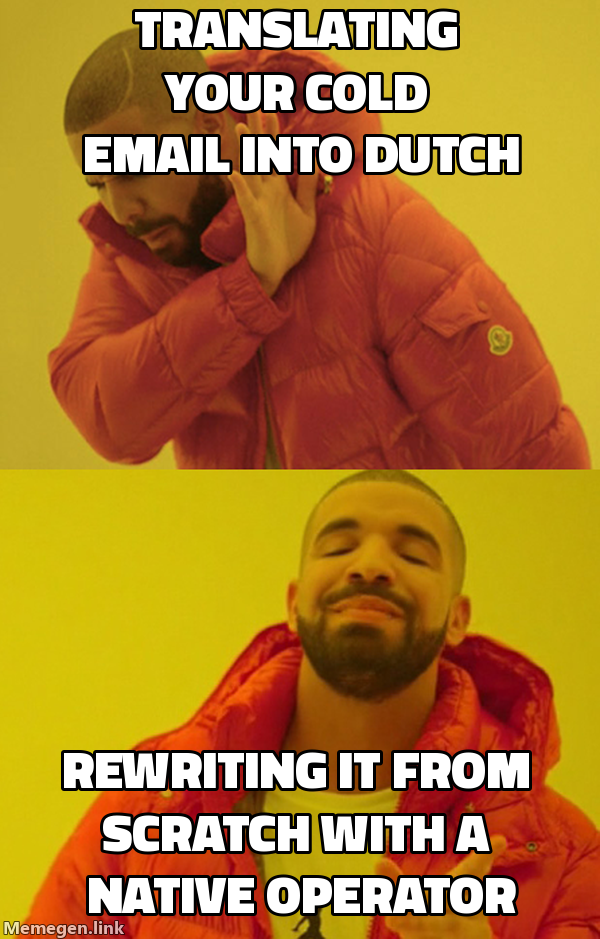 Translation moves words. A native rewrite moves the reply rate.
What actually changes per market
Each language is its own campaign, not a locale toggle. The copy, the formality, the proof, and the timing all shift.
| Market | Language | Formality | Opener that works | Best send window (local) |
|---|---|---|---|---|
| Turkey | Turkish | Warm, informal “sen” with founders, “siz” with corporates | Direct result + shared context | 08:30 to 10:00, 13:00 to 15:00 |
| Germany | German | Formal “Sie”, precise, no hype | Specific number + clear relevance | 07:00 to 09:00 Tue to Thu |
| Netherlands | Dutch | Direct, informal, low-fluff | Blunt value, one ask | 08:00 to 10:00, 16:00 to 17:00 |
| Gulf / MENA | Arabic | Respectful, relationship-first | Greeting + credibility before ask | 09:00 to 11:00, after Asr |
Germany: precision beats persuasion
Germans reward specificity and punish hype. Drop every adjective. Lead with a number and a reason this email is relevant to them specifically. Use formal “Sie” unless you have a signal that says otherwise. Keep the email shorter than your English version. A vague benefit statement that passes in the US gets deleted in Munich.
Netherlands: be blunt, lose the fluff
The Dutch are the most direct buyers in Europe. They will respect a one-line pitch and one clear ask. Skip the warm-up paragraph. If your value is real, say it plainly in the first sentence. Over-politeness reads as evasive here.
Turkey: warmth and context open the door
Turkish outbound runs on relationship and shared context. A relevant local reference, a shared connection, or a sharp result earns the reply. Tone is warmer than DACH. Practitioners generally see the strongest reply rates in this market when the ICP is tight.
Arabic and the Gulf: relationship before the ask
Arabic outbound is relationship-first. Open with a proper greeting and establish credibility before you ask for anything. Right-to-left rendering has to be clean. Respect prayer times and the Sunday-to-Thursday work week in most Gulf states. A cold ask in line one, which works in Amsterdam, closes the door in Riyadh.
The infrastructure that keeps you in the inbox
Native copy means nothing if you land in spam. Multilingual outbound multiplies your deliverability surface, so the setup has to be disciplined.
- Separate domains per market. Run dedicated secondary domains so a German campaign cannot torch the reputation of the Dutch one. One domain, one language, one reputation.
- Local sending domains where it matters. A
.deor.nlsender lifts trust and open rates with local buyers. It signals you are not a foreign blast. - Mailbox warmup before volume. Every new mailbox warms for two to three weeks before it touches a real list. No exceptions.
- Volume caps per inbox. Keep sends low per mailbox and scale by adding inboxes, not by pushing any single one harder. Filters punish spikes.
- Local-time scheduling. Each campaign fires in the recipient’s time zone and work week, not yours. A perfect German email sent at 3am Berlin time is a wasted email.
A typical send stack uses tools like Smartlead and Instantly for rotation and warmup, with sequencing handled separately. The principle is the same whatever you use: isolate reputation by market and never let one language drag down another. Google’s Email sender guidelines apply regardless of which market you target, so authentication and warmup are non-negotiable in every language.
Building GDPR-clean lists across borders
Europe is not the Wild West of US cold email. B2B outreach is workable under GDPR, but only if the list and the email are built right.
What keeps you compliant and effective:
- Legitimate interest, not consent farming. B2B cold email leans on legitimate interest. That means the offer has to be genuinely relevant to the recipient’s job. Relevance is both the legal basis and the conversion lever.
- Role-based targeting. Target the function and the fit, not scraped personal inboxes. Tight ICP filtering is what makes legitimate interest hold up.
- A real opt-out. Every email carries a clear, working unsubscribe and a real sender identity. No hiding.
- Germany runs tighter. DACH enforcement is stricter than the Netherlands or Turkey. Keep volume low, relevance high, and never improvise on consent.
Building lists with Apollo for raw data and Clay enrichment for verification means every contact is role-matched and email-validated before a single send. A clean, narrow list of 800 right-fit contacts beats 8,000 scraped addresses in every market, and it keeps you on the right side of the regulator.
How to run a four-language campaign end to end
Here is the actual operating sequence, not theory:
- One ICP, four list builds. Define the ideal customer, then build a separate verified list per market in Clay. Same fit criteria, local data.
- Native rewrite per language. A native operator writes each sequence from the offer, not from a translation. Hook, proof, and ask are reworked for the market.
- Domain and inbox isolation. Each market gets its own warmed domains and mailboxes. Reputation never crosses borders.
- Local-time, local-week scheduling. Sequences fire in the recipient’s time zone, respecting work weeks and holidays per region.
- Reply routing by language. Positive replies route to a responder who handles that language live. Speed to reply matters more than any subject line.
The right metrics to track per market are: positive reply rate, meetings booked, and cost per meeting in each language. If German underperforms, fix German copy and German timing in isolation, without touching the three markets that are working. Our outbound lead generation in Germany and cold email agency for the Netherlands both operate as fully isolated market campaigns.
What to expect, directionally
Benchmarks vary by ICP and offer, but the following ranges are commonly cited across the cold email industry:
- Turkish: typically among the stronger markets for reply rates, commonly landing around 4 to 8 percent positive on a tight list. Warmth and context pay off.
- Dutch: tends to land around 3 to 6 percent, when copy is blunt and the ask is single.
- German: generally lower volume of replies, around 2 to 4 percent, but high intent. Precision converts.
- Arabic: typically around 3 to 6 percent, slower to first reply, longer relationship runway, durable once open.
The lever is never the tool. It is native copy plus clean infrastructure plus a relevant, narrow list, repeated per market with discipline.
Run four languages as four real campaigns, not one campaign in four costumes, and the meetings follow.
Get the signal tier list in your inbox.
We rank signals from S to D to decide who gets a cold email and who does not. You get the list once. No follow-up emails.
Request received. The list lands in your inbox within 24 hours.
One more step: send the prepared request to [email protected]
FAQ
Should I translate my English cold email or rewrite it per language?
Rewrite it. Translation keeps English sentence rhythm and trips spam filters. Native operators rework the hook, the proof, and the ask for each market.
Is cold email legal in Germany and the Netherlands?
B2B cold email is workable under GDPR with legitimate interest, role-based targeting, a real opt-out, and a clear sender identity. Germany is stricter, so keep relevance tight and volume low per domain.
What reply rate should I expect across TR, DE, NL and AR?
Industry benchmarks vary widely, but directionally: Turkish campaigns typically land around 4 to 8 percent, Dutch around 3 to 6 percent, German around 2 to 4 percent, and Arabic around 3 to 6 percent. Tight ICP and native copy tend to move results toward the top of each range.
Do I need separate email domains for each language market?
Yes. Run dedicated secondary domains per market so a deliverability issue in one language cannot damage another. A .de or .nl sender domain also lifts trust with local buyers. Each domain warms independently for two to three weeks before touching a real list.
Can I use AI to write multilingual cold emails?
AI can draft structure, but the output needs a native reviewer before it sends. Machine-generated copy in German, Dutch, or Arabic often has subtle rhythm errors and unnatural phrasing that trained local readers catch immediately. Use AI to scale volume, then pass each language through a native operator for the final copy.
What is the right sending schedule for Gulf and MENA markets?
Gulf B2B operates Sunday to Thursday. Send between 09:00 and 11:00 local time, or after Asr in the early afternoon. Avoid Friday and Saturday entirely. Respect Ramadan hours when volume drops and decision cycles slow. Scheduling in the recipient's time zone, not yours, is non-negotiable.

Ahmet Faruk Yilmaz
Founder of Asphia. He builds and runs signal-based B2B outbound engines for lean teams, and has booked meetings with teams at companies across five markets. Writes about cold email, Clay, deliverability, and GTM engineering.
Want this run for you?
Get a free GTM analysis. We show you the exact engine we would build.
Get your free GTM analysis →