Prospeo vs Hunter vs Apollo Email Finder: Which One Actually Delivers Verified Emails?
September 8, 2025 · 4 min read · by Ahmet Faruk Yilmaz, Founder of Asphia
TL;DR
Prospeo returns verified emails with the highest accuracy for B2B outbound and costs less per valid result than Hunter.io in most use cases. Apollo gives the largest database but mixes verified and unverified results. For clean European data, Prospeo wins on deliverability; Hunter wins on simplicity; Apollo wins on volume.
The short answer: Prospeo wins on verified deliverability, Hunter wins on simplicity, and Apollo wins on raw volume. None of the three is complete on its own. The right stack depends on whether you care more about not bouncing or not missing anyone.
What each tool actually does
Prospeo is an email finder built specifically for B2B outbound. Its main workflow is LinkedIn-based: you provide a LinkedIn profile URL or run a bulk enrichment from a list, and Prospeo returns a verified email. The verification happens before the result is returned to you, which is the key operational difference.
Hunter.io is a domain-based email finder. You give it a company domain and it surfaces emails it has crawled from the public web, then assigns a confidence score. It also includes a verification step, but the underlying data source is domain crawling rather than profile-level enrichment. Hunter is the easiest tool in this category to get started with.
Apollo.io is a full go-to-market database rather than a standalone email finder. It includes company intelligence, job titles, org charts, and intent signals on top of contact emails. The tradeoff is that Apollo’s email accuracy is lower than tools that specialize only in verification. The database is large, the freshness varies.
Where each one falls short
Prospeo’s weakness is coverage. It returns fewer contacts per search than Apollo because it prioritizes accuracy over completeness. If a LinkedIn profile is private or a contact has no clear LinkedIn presence, Prospeo may return nothing. You will not find emails for everyone on a large list using Prospeo alone.
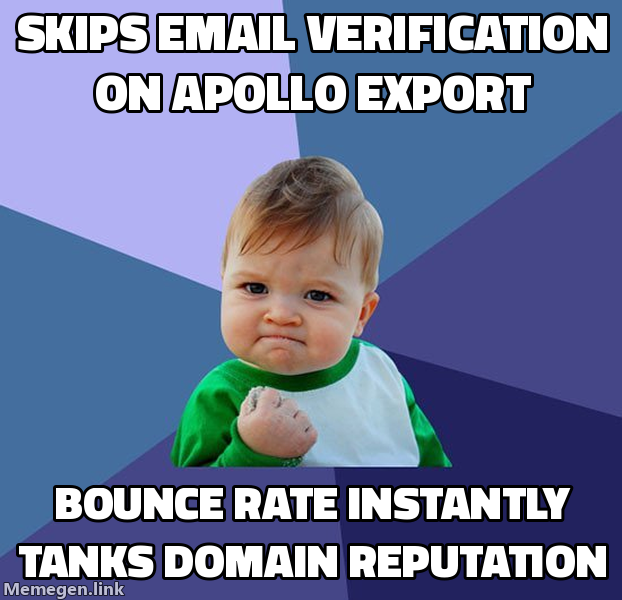 Apollo finds the contacts. A verification step decides whether your domain survives the send.
Hunter’s weakness is pattern-dependency. It works well when a company has a consistent email format across many employees and those addresses have appeared publicly online. For newer companies, smaller firms with low web presence, or international contacts outside English-speaking markets, Hunter’s hit rate drops. Its GDPR handling is also self-managed: Hunter provides the data but you own the compliance decisions.
Apollo’s weakness is data quality at the point of sending. Because the database is enormous, it contains stale data and catch-all addresses. Sending directly from an Apollo export without verification is one of the fastest ways to damage your sender reputation. Most serious outbound operations treat Apollo as a discovery layer and run the contacts through a secondary verifier before loading them into a sending platform.
How professional outbound teams actually use these tools
A common waterfall that works in practice looks like this. Use Apollo for broad list building: filter by industry, company size, geography, and job title to generate a candidate list. Export that list and run it through Prospeo or a dedicated verifier like LeadMagic or ZeroBounce to remove invalid and catch-all addresses. Import only the verified subset into your sending platform.
Hunter fits a narrower workflow: you have a short list of target companies and you need to find one or two contacts at each without building a larger database. For that task, Hunter is fast and the interface is clean.
For clay-based enrichment pipelines, teams often pull LinkedIn profile URLs from Sales Navigator or a scraping step, then route them through Prospeo’s bulk enrichment to get verified emails before personalizing outreach. This keeps bounce rates low without requiring a separate verification vendor.
Cost and credit efficiency
All three tools use credit-based pricing. The relevant metric is not the price per credit but the price per valid delivered email, which means factoring in the bounce or catch-all rate. Prospeo tends to have a higher cost per credit than Hunter on paper but produces more valid results per credit spent, which often makes it cheaper per actual deliverable address.
Apollo’s pricing has changed multiple times. At the volume tiers where it makes sense as a database (thousands of contacts per month), it is competitive, but the verification overhead you need to add afterward raises the effective cost.
If you are running GDPR-compliant outbound in Europe, Prospeo’s verification-first approach also reduces the data-quality risk. Holding large sets of unverified personal contact data for longer than necessary is a risk under GDPR’s storage-limitation principle. Smaller, verified exports are cleaner from a compliance perspective. For a deeper look at running outbound in European markets, see our guide on GDPR-compliant cold email.
Which one should you choose
Use Prospeo if accuracy and low bounce rate are your primary constraints, especially for LinkedIn-sourced lists or European B2B outreach.
Use Hunter if you need a quick, simple lookup by company domain and want an interface that requires no setup.
Use Apollo if you need large-scale prospecting with company intelligence baked in, but plan to verify outputs before sending.
Most outbound operations end up using two of these together. The goal is clean data at the point of send, not a single perfect source. If you want to see how we combine these tools inside a fully managed outbound system, the done-for-you cold email service page walks through the full data and sending stack we run for clients.
Get the signal tier list in your inbox.
We rank signals from S to D to decide who gets a cold email and who does not. You get the list once. No follow-up emails.
Request received. The list lands in your inbox within 24 hours.
One more step: send the prepared request to [email protected]
FAQ
Is Prospeo more accurate than Hunter.io for finding business emails?
Prospeo focuses exclusively on verified B2B emails and tends to produce lower bounce rates than Hunter in practice. Hunter has broader brand recognition and a simpler interface, but Prospeo's accuracy on European professional email addresses is generally stronger.
Can I use Prospeo, Hunter, or Apollo for GDPR-compliant cold email in Europe?
All three operate on legitimate-interest grounds for B2B contact data, but none of them make you automatically GDPR-compliant. You still need to document your lawful basis, honor opt-outs, and avoid consumer data. Prospeo's verification focus reduces the risk of holding stale personal data, which matters under storage-limitation rules.
Does Apollo verify emails before showing them?
Apollo's database contains both verified and unverified addresses. It flags confidence levels, but you will still encounter catch-all results and bounces if you send without a secondary verification step. Running Apollo exports through a dedicated verifier before sending is standard practice.
What is the best email finder for cold email agencies?
Most cold email agencies waterfall: they pull contacts from Apollo for volume, then verify with a dedicated tool like Prospeo or a service like LeadMagic or ZeroBounce before importing into a sending tool. Using one source alone leaves gaps in coverage or accuracy.
Is Hunter.io good for finding emails at small companies?
Hunter is strong at identifying common email patterns for smaller companies where domain-level pattern detection works well, such as [email protected]. For less common patterns or companies without a clear web presence, Prospeo's LinkedIn-based enrichment often fills gaps Hunter cannot.
Which email finder has the best LinkedIn integration?
Prospeo's core workflow is built around LinkedIn enrichment, including a Chrome extension that finds emails directly from LinkedIn profiles. Apollo also integrates with LinkedIn but its strength is database volume. Hunter relies primarily on domain crawling and does not have a native LinkedIn enrichment flow.

Ahmet Faruk Yilmaz
Founder of Asphia. He builds and runs signal-based B2B outbound engines for lean teams, and has booked meetings with teams at companies across five markets. Writes about cold email, Clay, deliverability, and GTM engineering.
Want this run for you?
Get a free GTM analysis. We show you the exact engine we would build.
Get your free GTM analysis →