B2B Outbound for Manufacturing Companies: How to Reach Plant Managers and Procurement Leads
February 8, 2026 · 5 min read · by Ahmet Faruk Yilmaz, Founder of Asphia
TL;DR
Outbound for manufacturing companies works best when you lead with operational pain (downtime, supplier risk, yield loss) rather than features. Target plant managers and procurement leads via cold email and LinkedIn using firmographic and event-based signals. Expect longer cycles but higher deal values than most B2B verticals.
Outbound for manufacturing companies is one of the highest-value, most underserved motions in B2B sales. The buyers are hard to reach, cycles are long, and most software vendors write generic copy that misses entirely. Get the signal, the persona, and the framing right and you can book consistent meetings with plant managers and procurement leads who rarely respond to anything.
Why Manufacturing Outbound Is Different
Manufacturing buyers are not browsing LinkedIn for vendors. A plant manager’s day is on the floor, not in their inbox. A procurement director is managing supplier scorecards, not reading cold emails about “streamlining workflows.”
The core difference: these personas respond to operational language, not software language. “Reduce unplanned downtime” lands. “AI-powered workflow automation” does not.
Deal values in manufacturing also tend to be large. A single closed account can be worth more than an entire quarter of pipeline in faster-moving verticals. That justifies a more patient, more personalized approach and more effort per lead.
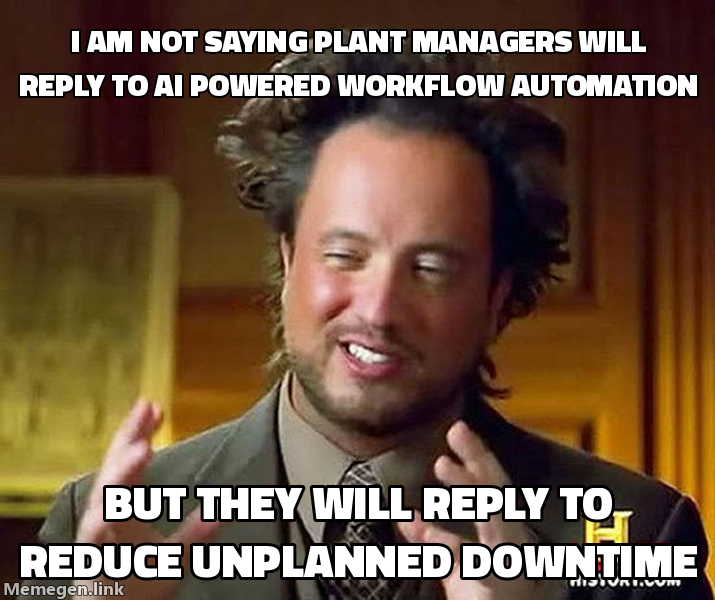 Operational language lands. Software language does not.
The Right Personas to Target
Two personas drive most manufacturing deals.
Plant managers and operations directors own the day-to-day. They feel production inefficiency, supplier delays, and quality escapes personally. If your solution solves something on the floor, this is your champion. They have influence, but rarely sign contracts alone.
Procurement and supply chain managers control vendor relationships and budgets. They are often the economic buyer or the gatekeeper to one. They think in terms of cost, reliability, and compliance, not features.
In companies under 200 employees, the owner or VP of Operations often wears both hats. At that size, go direct to the top.
Title targeting matters here more than in most verticals. “Operations Manager” at a 50-person precision parts shop means something very different from “Operations Manager” at a 2,000-person automotive supplier. Layer firmographic filters (revenue, employee count, NAICS code, sub-vertical) on top of title to get to the right slice.
Signal-Based Targeting: What to Look For
Generic list pulling from Apollo or LinkedIn does not cut it in manufacturing. The accounts that convert are the ones with a visible reason to buy now.
The best signals for manufacturing outbound:
Hiring signals. A company posting for a “Production Supervisor” or “Quality Engineer” is scaling capacity. A post for a “Supply Chain Analyst” suggests they are investing in procurement infrastructure. Both are buying signals for vendors who solve operational problems.
Technology installs and migrations. If a manufacturer is switching ERPs, they are also evaluating adjacent systems: MES, QMS, inventory software, supplier portals. Data providers like Clay can surface these installs, giving you a timely hook.
Facility announcements. New plant openings, expansion announcements, or moves are public and searchable. A greenfield facility needs everything. Mention the announcement directly in your opening line.
Certification pursuits. Manufacturers pursuing ISO 9001, IATF 16949, AS9100, or similar certifications have immediate, documented pain around compliance and documentation. If your product helps, this signal is extremely high-intent.
A Clay enrichment service can pull and score these signals at scale, so your outreach goes to the accounts where something is actually happening, not just accounts that fit the profile.
Cold Email and LinkedIn: What Works in This Vertical
Manufacturing outreach requires patience and operational credibility in every line.
Subject lines should be specific and problem-adjacent. Reference the industry, the role, or a specific operational problem. Vague curiosity hooks (“Quick question”) underperform against specific ones (“ISO 9001 prep at [Company]”).
Opening lines should lead with their world, not yours. A strong opener references what they are dealing with: a regulation they have to comply with, a hiring move you noticed, a facility they just opened. This is not flattery. It is proof you did homework.
Body copy should be short (under 100 words) and frame one concrete outcome. Avoid feature lists. Avoid jargon that sounds like it came from a SaaS landing page. Write the way a plant manager talks about problems.
Call to action should be low-friction. “Worth a 20-minute call?” outperforms “Schedule time on my calendar here” in operational verticals where buyers are skeptical of automated sales processes.
For LinkedIn, connection requests with a short, contextual note work better than InMail in most cases. Connect first, then message. Multichannel sequences that touch a prospect on both email and LinkedIn see meaningfully higher reply rates than email alone.
If you want to see how this is structured end to end, our managed outbound service and done-for-you cold email options both cover manufacturing as a vertical.
Compliance When Targeting European Manufacturers
If you are targeting manufacturers in Germany, the Netherlands, or other EU markets, GDPR applies to how you collect and use contact data. B2B cold email is permitted under legitimate interest in most EU jurisdictions, but you need documented reasoning, a clear opt-out in every email, and a reliable suppression process.
The GDPR guidance at gdpr.eu covers the core requirements. Working with a GDPR-compliant cold email agency that builds suppression and opt-out handling into the infrastructure from day one is far cleaner than retrofitting compliance onto an existing sequence.
For outreach into Germany specifically, localized copy in German also performs better than English-only, even with international procurement teams. Our team runs sequences in German, Dutch, and English depending on the target market.
Realistic Expectations
Manufacturing outbound is not a high-volume, quick-cycle motion. Expect sequences of six to eight touches. Expect reply rates that are lower than SaaS outbound but deal sizes that are higher. Expect buyers who need three to four conversations before they move.
The teams that succeed here treat outbound as a precision instrument, not a spray-and-pray list. Tight ICP, verified contacts, operational copy, and consistent follow-through over four to six weeks per cohort. That combination books meetings with buyers who almost never respond to anything else.
If you are building this motion in-house, our done-with-you outbound program walks through the full build: ICP definition, signal sourcing, sequence architecture, and tooling. The system stays in your stack when we are done.
Get the signal tier list in your inbox.
We rank signals from S to D to decide who gets a cold email and who does not. You get the list once. No follow-up emails.
Request received. The list lands in your inbox within 24 hours.
One more step: send the prepared request to [email protected]
FAQ
Does cold email work for manufacturing companies?
Yes, but it requires operational framing. Plant managers and procurement leads respond to messages that reference specific pain points like production downtime, supplier consolidation, or compliance requirements. Generic benefit-led emails perform poorly in this vertical.
Who should I target in a manufacturing company?
The two highest-leverage personas are plant managers or operations directors (who feel the pain directly) and procurement or supply chain managers (who control the vendor relationship). In smaller manufacturers, the owner or VP of Operations often covers both roles.
What signals work for manufacturing outbound?
Look for hiring signals (new production supervisor roles suggest capacity expansion), technology install signals (ERP migrations open the door for adjacent vendors), recent facility announcements, and industry certification pursuits like ISO 9001 or IATF 16949.
How many touches does it take to book a meeting with a manufacturing buyer?
Manufacturing buyers tend to be conservative and have long decision cycles. A sequence of five to eight touches across email and LinkedIn over three to four weeks is common before you see meaningful reply rates. Persistence combined with relevance is the differentiator.
Is LinkedIn or cold email better for manufacturing outreach?
Both channels are effective when combined. Cold email reaches plant-floor and operations personas who are not active on LinkedIn. LinkedIn works well for supply chain and procurement titles who are more digitally active. A multichannel sequence outperforms either channel alone.
How do I avoid GDPR issues when emailing European manufacturers?
For B2B cold email to EU-based companies, legitimate interest is the most commonly used GDPR basis. You must document your reasoning, include a clear opt-out in every email, honor unsubscribes promptly, and avoid personal data beyond what is necessary. Working with a GDPR-native agency reduces compliance risk.

Ahmet Faruk Yilmaz
Founder of Asphia. He builds and runs signal-based B2B outbound engines for lean teams, and has booked meetings with teams at companies across five markets. Writes about cold email, Clay, deliverability, and GTM engineering.
Want this run for you?
Get a free GTM analysis. We show you the exact engine we would build.
Get your free GTM analysis →