Unsubscribe Handling for European Cold Email: The Right Process to Stay GDPR-Safe at Scale
March 26, 2026 · 5 min read · by Ahmet Faruk Yilmaz, Founder of Asphia
TL;DR
Every cold email to EU prospects must include a clear unsubscribe mechanism, and opt-out requests must be honored within 30 days (most senders do it immediately). Log every request, suppress permanently, and never re-add removed contacts. Suppression lists, not deletion alone, are how you stay GDPR-safe at scale.
The short answer: every opt-out request from an EU prospect must be honored immediately, logged permanently in a suppression list, and never re-added to any future campaign. That is not optional under GDPR. The longer answer is about building a process that holds up under volume without creating operational drag.
Why Unsubscribe Handling Is a Legal Requirement, Not a Courtesy
GDPR Article 21 gives individuals the right to object to processing of their personal data for direct marketing purposes. The moment that objection is received, you must stop processing for that purpose. For cold email, that means suppressing the contact instantly, not at the next list refresh.
This is separate from the ePrivacy Directive (which governs consent for cookies and electronic communications in some member states). Both apply to outbound email targeting EU prospects, and both reinforce the same operational conclusion: your outbound infrastructure needs a suppression mechanism that fires before the next send, not after.
For a practical reference on the legal framework, the official gdpr.eu guidance on the right to object is worth bookmarking.
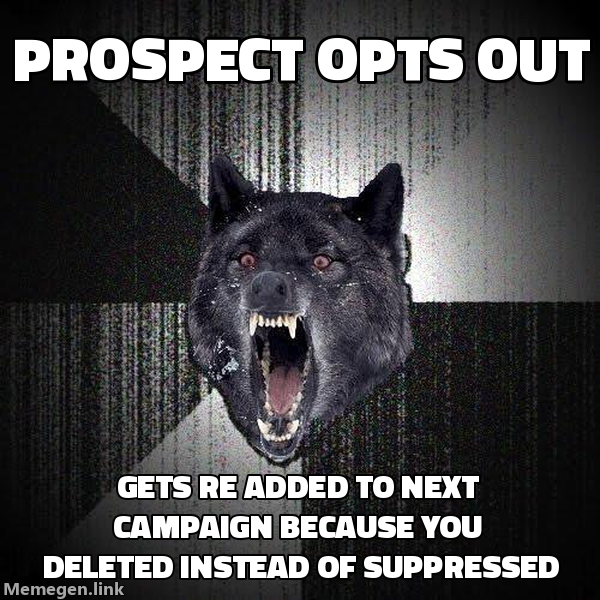 Deletion is not suppression. Six months later, your new import proves it.
The Four-Part Suppression Process
Getting this right at scale requires four distinct components working together.
1. Opt-out capture. Every cold email needs a mechanism that a recipient can use without friction. A one-click link that appends a URL parameter is the most reliable approach because it requires no reply handling. A reply-based instruction (“reply with Remove”) works too, but requires inbox monitoring that many teams skip. Whichever method you use, it must work on mobile and must not require the recipient to log in or fill out a form.
2. Real-time suppression. When an opt-out fires, the contact must be removed from all active sequences immediately. If your sending platform does not support real-time webhooks for unsubscribes, that platform is not suitable for European outbound. Most professional tools (Smartlead, Lemlist, Instantly, Manyreach) support this natively. The test is simple: trigger a test unsubscribe and check whether the contact is blocked from the next scheduled step within seconds, not hours.
3. Permanent suppression list. This is the part most teams get wrong. They remove the contact from the current campaign but do not add the email to a global suppression list. Six months later, a new campaign sources a fresh list from Apollo or Clay, the same email appears, and the person gets contacted again. That is a GDPR violation. Your suppression list should contain the email address, the opt-out timestamp, and the channel, and it should be checked against every new import before any contact enters a sequence. See how a GDPR-compliant cold email agency operationalizes this in practice.
4. Documentation and audit trail. If a data protection authority asks how you handle opt-outs, you need to show them a log, not just a policy document. Store suppression records for as long as you are running outbound campaigns, and make them exportable. This is your proof of compliance.
Common Mistakes That Create Compliance Risk
The mistakes that cause real GDPR problems are not usually deliberate. They are operational gaps.
Importing unsuppressed lists. A new list arrives from a data provider. Someone runs an import directly into the campaign without checking it against the suppression list. This is the most common source of repeat contacts to opted-out prospects.
Treating unsubscribe as channel-specific. If someone opts out of email, suppressing them from email only is a reasonable starting point. But if your outreach is multi-channel (email plus LinkedIn, for example), a clear opt-out request should trigger suppression across all channels. When in doubt, suppress everywhere.
Relying on ESP-level suppression only. Your email service provider maintains its own unsubscribe list. That list does not automatically transfer to your CRM, your enrichment tool, or your next campaign if you switch ESPs. Maintain your own master suppression file independent of any single platform.
No process for manual opt-out requests. Some prospects will reply with “please remove me” rather than clicking a link. That reply must be treated with the same urgency as a one-click opt-out. If your inbox is not monitored, those requests get missed. The AI cold email spam avoidance playbook covers inbox monitoring as part of compliance hygiene.
How This Works Inside a Managed Outbound System
At Asphia, suppression handling is built into the infrastructure before any campaign goes live. Every contact import is checked against a global suppression list. Unsubscribes from any active campaign trigger immediate removal from all sequences via webhook. The suppression list is maintained independently of the sending platform so it persists across tool changes.
This is part of what makes a done-for-you cold email approach operationally different from a company running outbound in-house for the first time. The compliance layer is pre-built, not retrofitted after a complaint.
For teams building their own system, the same logic applies. Before you send a single email to a European prospect, confirm that your suppression list exists, that it is checked at import time, and that your sending platform supports real-time opt-out webhooks. Those three things cover the majority of GDPR compliance risk in outbound email. Everything else is documentation. For a broader look at how European B2B lead generation should be structured, the B2B lead generation agency Europe overview covers the data sourcing and compliance layer together.
Unsubscribe handling is not the most exciting part of building an outbound system. It is the part that determines whether you can keep running it.
Get the signal tier list in your inbox.
We rank signals from S to D to decide who gets a cold email and who does not. You get the list once. No follow-up emails.
Request received. The list lands in your inbox within 24 hours.
One more step: send the prepared request to [email protected]
FAQ
Is unsubscribe required in cold B2B email under GDPR?
GDPR does not mandate a literal unsubscribe link in every cold email, but it does require that recipients can object to processing at any time and that you act on that objection promptly. In practice, including a clear opt-out mechanism in every email is the only reliable way to meet that obligation without support tickets.
How quickly must I honor a GDPR unsubscribe request?
GDPR requires you to stop processing personal data as soon as the objection is received, and to confirm compliance without undue delay. Most legal guidance interprets this as within 30 days at most, though the industry standard for cold email is immediate suppression at the moment the opt-out is recorded.
Can I delete an unsubscribed contact instead of suppressing them?
Deletion alone is risky. If you delete the record entirely, you lose proof that the person unsubscribed. The next time you purchase or source a list that includes them, they could be contacted again. A suppression list (email address plus opt-out timestamp, nothing else) is the correct approach: it blocks future sends while meeting your accountability obligations.
What should a GDPR-compliant cold email unsubscribe mechanism look like?
It can be a one-click link, a reply instruction (e.g., 'reply with Remove'), or a landing page. The key requirements are that it is easy to find, does not require login or account creation, and triggers immediate suppression in your sending platform. One-click is strongly preferred because friction increases complaints.
Does unsubscribe apply to LinkedIn outreach as well as email?
LinkedIn messages are governed by LinkedIn's own terms and GDPR simultaneously. If someone asks you to stop messaging them on LinkedIn, you must honor that request and suppress them across all channels, including email, if the suppression request is channel-agnostic.
Do I need a separate suppression list per country in Europe?
Not necessarily per country, but you need to track the legal basis for each contact. Because GDPR applies across the EU and EEA, a single suppression list covering all European contacts is typically sufficient, provided you record the opt-out date and can demonstrate compliance to any data protection authority that asks.

Ahmet Faruk Yilmaz
Founder of Asphia. He builds and runs signal-based B2B outbound engines for lean teams, and has booked meetings with teams at companies across five markets. Writes about cold email, Clay, deliverability, and GTM engineering.
Want this run for you?
Get a free GTM analysis. We show you the exact engine we would build.
Get your free GTM analysis →